A phone outage rarely stays a phone problem for long. For a school district, it can disrupt parent communication and emergency coordination. For a healthcare-adjacent contractor or public agency, it can delay urgent conversations, interrupt service delivery, and create documentation headaches. That is why business phone system redundancy matters – not as a technical add-on, but as a core part of operational continuity.
Many organizations still assume redundancy means having a backup internet circuit or a spare handset in a closet. In practice, that is only one piece of the picture. If your voice environment depends on a single carrier route, one on-premises appliance, or one office location staying online, you still have a single point of failure.
What business phone system redundancy actually means
Business phone system redundancy is the deliberate design of alternate paths, systems, and failover processes that keep voice service available when part of the environment fails. That failure could be local, like a power outage in one office, or upstream, like a carrier interruption, equipment issue, or regional network event.
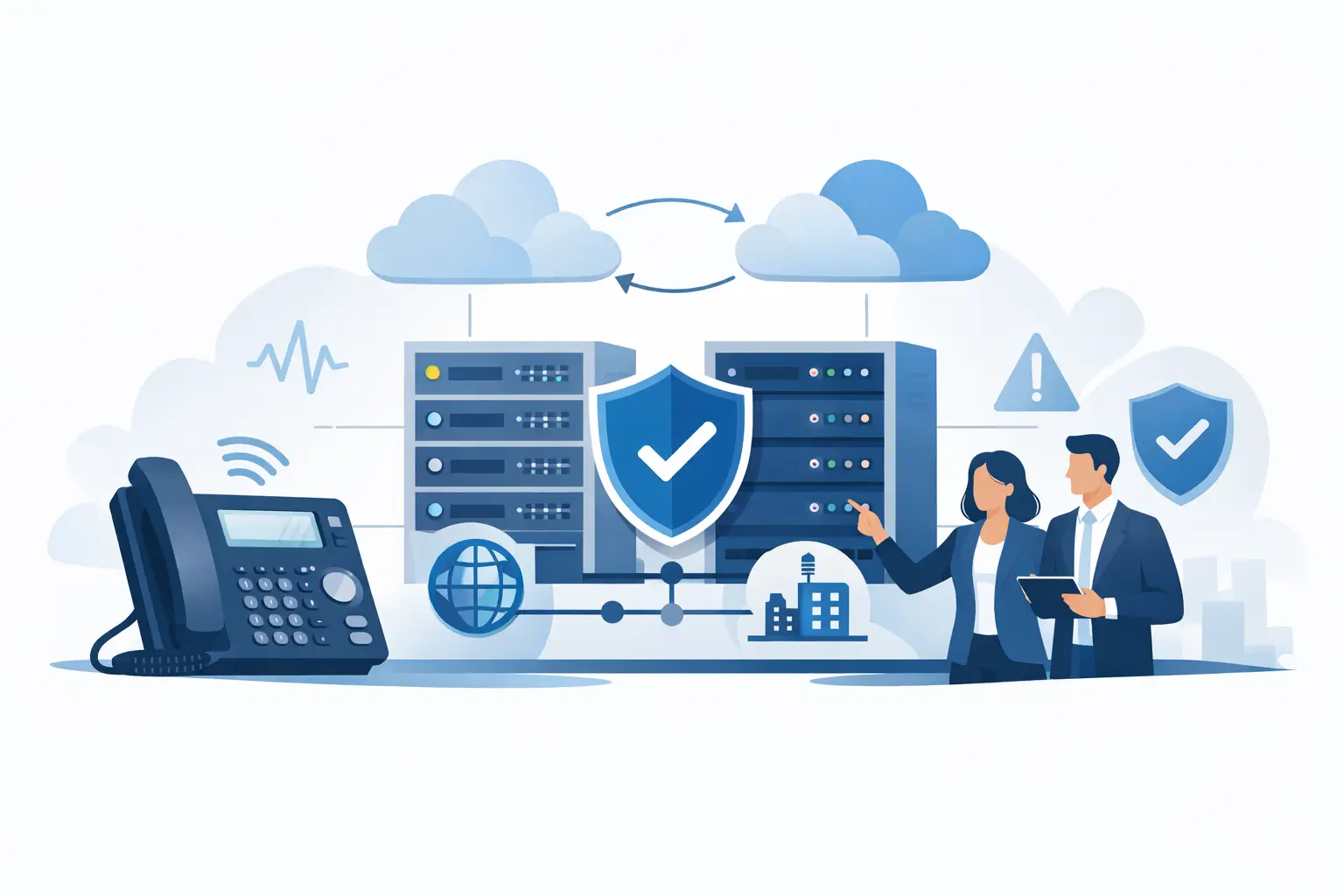
In a modern cloud voice environment, redundancy can exist at several layers. The calling platform may run across multiple geographically separated data centers. SIP connectivity may have alternate routing. Numbers may be able to fail over to other users, hunt groups, mobile devices, or secondary locations. Network connectivity may be diversified with primary and backup circuits. Administrative controls may allow your team to reroute calls quickly without waiting for a truck roll.
The key point is simple: redundancy is not one feature. It is an architecture.
The cost of getting redundancy wrong
For most IT and operations leaders, the real question is not whether an outage is possible. It is how much disruption the business can tolerate while the issue is resolved.
In some environments, a few minutes of downtime is manageable. In others, it is not. A public-sector office may need inbound lines available during business hours for constituent support. A distributed sales team may lose opportunities if calls fail or voicemail stops syncing. A government contractor may face greater scrutiny if communications disruptions affect responsiveness, escalation paths, or continuity planning.
There is also a less visible cost. When voice service is unreliable, teams create workarounds. They start publishing personal cell numbers, forwarding calls informally, or relying on disconnected tools across departments. Those habits make administration harder, weaken security controls, and complicate compliance.
That is why redundancy should be evaluated against business impact, not just telecom spend. A lower-cost service with limited failover options can become expensive very quickly when availability matters.
Where failures usually happen
Redundancy planning improves when you stop thinking only about catastrophic outages. Most service interruptions come from ordinary weak points.
A single ISP serving a main office is one common example. If that circuit fails and voice traffic has nowhere else to go, cloud calling still goes down for users at that site. Another issue is dependence on legacy hardware. Aging PBX equipment, PRI circuits, analog gateways, or unsupported session border components can fail in ways that are slow to diagnose and harder to replace.
Carrier concentration is another risk. Even when an organization has moved to VoIP, it may still rely on one provider route or one local delivery path for all inbound and outbound traffic. Administrative bottlenecks matter too. If only one person knows how to reroute numbers during an incident, recovery can take longer than it should.
A strong redundancy strategy accounts for technical failure and operational delay.
How to evaluate business phone system redundancy
The right design depends on your organization’s size, risk tolerance, user distribution, and compliance obligations. A single-site business with moderate call volume does not need the same configuration as a multi-location agency or a GCC High environment handling sensitive communications. Still, the evaluation should follow a clear set of questions.
Start with your critical call flows
Identify which numbers and call paths cannot go down. That may include main numbers, contact center queues, after-hours emergency lines, elevator and safety phones, admissions offices, help desks, or executive lines.
Then ask what happens if a site loses power, if the WAN fails, if your primary voice route goes down, or if an administrator is unavailable. If the answer is “we would figure it out,” your redundancy plan is not finished.
Look at failover time, not just failover capability
Many providers advertise backup options, but the practical question is how quickly those options activate and how much manual intervention they require. Automatic failover is not the same as submitting a support request during an outage.
For high-dependency environments, you should understand whether failover is immediate, whether users need to sign back in, whether number routing changes are self-service, and whether backup destinations have already been tested.
Check the layers, not one feature
A redundant voice environment typically involves platform redundancy, carrier redundancy, network redundancy, and endpoint flexibility. If only one of those layers exists, you may still be exposed.
For example, a cloud platform with resilient data centers is valuable, but users in a branch office can still lose calling if the branch relies on one circuit and no mobile or alternate routing plan exists. Likewise, dual internet circuits help, but they do not solve a provider-side routing issue by themselves.
Include compliance and security requirements
For regulated organizations, redundancy decisions cannot be separated from security architecture. Alternate call paths, mobile routing, and backup access methods should align with the organization’s policies for authentication, logging, data handling, and approved environments.
That is especially important in government, education, and contractor settings where continuity must coexist with requirements tied to FedRAMP, GCC High, or similar controls. A workaround that restores calling but creates a compliance issue is not a complete solution.
What a resilient voice design often includes
The most effective designs balance availability with manageability. That usually means moving away from a patchwork of local carriers, aging hardware, and manual forwarding rules toward a more centralized cloud voice model.
A resilient design often includes geo-redundant hosting, diversified SIP routing, and number failover that can direct calls to alternate users, devices, or sites. It also includes user flexibility. If employees can continue answering business calls from a secure softphone or approved mobile endpoint during a site outage, the organization has more options.
Network diversity also matters. In some cases, that means dual wired providers. In others, it may involve wireless backup for smaller locations or critical teams. The right answer depends on budget and site importance. Not every office needs the same level of protection, but every office should have a documented recovery path.
Another piece that is often overlooked is administrative simplicity. During an outage, your team should be able to make routing changes quickly and confirm that failover is working. Complex recovery steps create their own risk.
The trade-off between cost and continuity
Redundancy is an investment, and there is no value in pretending otherwise. More diverse routing, backup connectivity, and higher-availability infrastructure can increase monthly costs. The real decision is whether those costs are justified by the operational consequences of downtime.
For some organizations, a tiered model makes the most sense. Protect primary numbers, public-facing departments, and critical service lines at a higher level, while giving lower-risk locations simpler backup options. That approach keeps spending aligned to business impact.
It is also worth recognizing that modernization can offset part of the redundancy investment. Replacing multiple legacy lines, maintenance contracts, and isolated systems with a centralized cloud voice service can improve availability while reducing complexity and support overhead.
Choosing a provider that can support redundancy
A provider should be able to explain redundancy in plain terms, not hide behind generic uptime language. Ask how calls are routed during carrier issues, what geographic diversity exists in the platform, how number failover is handled, and what happens when a customer site loses connectivity.
You should also ask who helps design the environment. Redundancy is not just a product checkbox. It should reflect your call flows, locations, compliance needs, and tolerance for interruption. A consultative provider will map those requirements before recommending architecture.
For organizations in regulated environments, provider experience matters even more. Security, continuity, and compliance are closely linked, and the voice design should reflect all three. Intuity works with organizations that need that level of planning because a business phone system is not just another utility – it is a critical operational service.
The best time to test your redundancy plan is before anyone needs it. If your current answer to an outage is still “forward the main line and hope for the best,” there is room to build something more dependable.