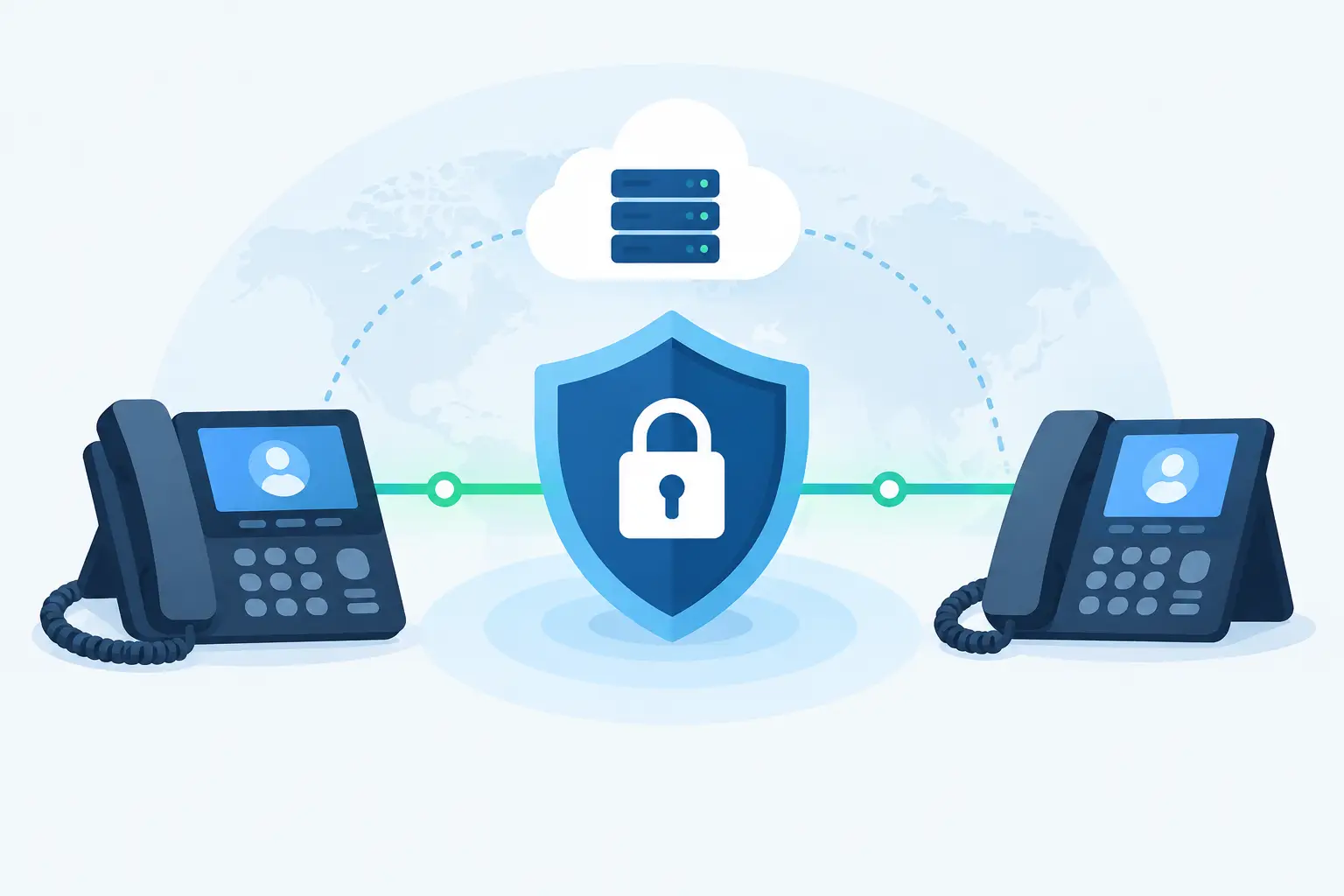
A SIP trunk can carry more than dial tone. Signaling data may expose extension numbers, call-routing details, and caller information. Media streams can contain sensitive conversations involving customers, students, patients, employees, or agency operations. To configure SIP trunk encryption correctly, organizations need to protect both components without creating certificate, firewall, or interoperability problems that affect call quality.
For most enterprise deployments, the practical standard is TLS for SIP signaling and SRTP for voice media. The configuration itself is only part of the job. Security depends on how the session border controller (SBC), IP-PBX, carrier connection, certificates, network policies, and monitoring procedures work together.
What SIP Trunk Encryption Protects
SIP is the signaling protocol that establishes, changes, and ends a call. It communicates details such as the originating endpoint, destination, codec selection, and session instructions. Transport Layer Security (TLS) encrypts this signaling traffic and verifies the identity of the service endpoint through digital certificates.
The actual audio takes a separate path as Real-time Transport Protocol traffic. Secure Real-time Transport Protocol (SRTP) encrypts the media stream so a party monitoring the network cannot simply reconstruct the call audio. In a typical SIP trunk design, TLS protects the control plane while SRTP protects the voice payload.
Using one without the other leaves a gap. TLS without SRTP can conceal dialing instructions while leaving media exposed. SRTP without TLS can encrypt audio but still reveal call metadata and allow signaling to be observed or altered. For organizations handling regulated or confidential information, both should be treated as the baseline design when supported by every component in the call path.
Encryption in transit is not the same as full compliance. It does not replace access controls, retention policies, incident response, audit logging, or a documented vendor review. It does, however, address a foundational communications security requirement.
Before You Configure SIP Trunk Encryption
Start with an inventory of the call path. Identify the PBX or unified communications platform, SBC, firewall, internet circuits, branch locations, remote users, and the SIP trunk provider‘s handoff requirements. Encryption settings must align across these systems. A single device that only supports unencrypted SIP or RTP can force a redesign, an upgrade, or a carefully controlled exception.
Confirm the provider’s supported standards before changing production settings. Ask which SIP transport and port are required, whether TLS 1.2 or TLS 1.3 is supported, which cipher suites are acceptable, whether SRTP uses SDES keying, and whether mutual TLS is available or required. Also confirm whether the carrier expects a public certificate, provides a private certificate authority, or authenticates trunks by source IP in addition to certificates.
This is where many projects encounter avoidable trouble. A PBX may be configured for TLS, but its certificate common name or subject alternative name does not match the fully qualified domain name used by the provider. The result is failed registration, rejected calls, or a tempting but unsafe decision to disable certificate validation.
Establish the right edge design
Place the SIP trunk connection behind a properly configured SBC whenever the environment warrants it. An SBC acts as the controlled border between the internal voice environment and the carrier network. It can normalize SIP messages, enforce TLS and SRTP policies, manage NAT traversal, limit fraudulent call attempts, and provide detailed diagnostics during an outage.
Smaller organizations may use a cloud PBX or provider-managed SBC instead of operating their own appliance. The security objective remains the same: do not expose an internal PBX directly to the public internet unless the design and vendor guidance explicitly support it. For distributed organizations, local survivability and redundant SBC placement may also be necessary when voice continuity is a business requirement.
How to Configure SIP Trunk Encryption
The exact fields differ among PBXs, SBCs, and cloud platforms, but the implementation sequence is consistent.
1. Enable TLS for SIP signaling
Set the SIP transport for the trunk to TLS rather than UDP or unencrypted TCP. Port 5061 is common for SIP over TLS, although the provider may use a different port. Configure the provider’s fully qualified domain name as the target, not only an IP address, when certificate validation depends on hostname matching.
Install a valid certificate and the required intermediate certificates on the device presenting TLS. Use a certificate from a trusted authority or the carrier’s designated private authority, based on the service design. The certificate must be current, include the correct hostnames, and be stored with its private key protected.
Configure the system to validate the provider certificate chain and hostname. Avoid settings labeled “accept any certificate,” “ignore certificate errors,” or their equivalent. They may speed up testing, but they defeat a central security control by making impersonation attacks harder to detect.
2. Require SRTP for voice media
Set media encryption to SRTP and, where policy permits, require it rather than merely preferring it. A preference-based setting may allow an endpoint to fall back to RTP when negotiation fails. That can be useful during a staged migration, but it should not become a permanent default for sensitive calling environments.
For many carrier trunks, SRTP keys are exchanged through SDES attributes in the SIP session description. Because those keys travel within the signaling exchange, TLS is essential. Some endpoint-to-platform deployments use DTLS-SRTP instead. Use the method supported by the specific trunk and platform rather than assuming all SRTP implementations interoperate.
Choose supported cipher suites and encryption profiles based on the provider and your platform’s current documentation. Compatibility matters. An overly restrictive policy can cause one-way audio, failed call setup, or calls that connect but have no encrypted media path.
3. Apply disciplined firewall and network rules
Allow inbound and outbound traffic only for the carrier’s published signaling and media ranges. SIP signaling and RTP media use different ports, and media ranges are often broader than administrators expect. Keep those rules as narrow as operationally possible, document their purpose, and review them when the provider changes infrastructure.
Disable consumer-grade SIP application-level gateways (SIP ALG) unless the voice vendor explicitly requires them. These features often rewrite SIP headers or session descriptions and can interfere with TLS, SRTP negotiation, and NAT handling. Let the SBC or supported PBX manage SIP-aware functions instead.
Separate voice infrastructure from general user traffic when the network design allows it. VLAN segmentation, quality-of-service policies, access controls, and redundant internet paths do not encrypt calls, but they reduce exposure and help encrypted voice maintain acceptable quality under load.
4. Use authenticated trunk access
Encryption protects the session, but it does not by itself prove that every call request is authorized. Use the provider’s supported authentication model, which may include IP allowlisting, digest authentication, mutual TLS, or a combination of controls.
Limit administrative access to the PBX and SBC through multifactor authentication, role-based permissions, and restricted management networks. Attackers frequently target the administrative plane to change call forwarding, create international dialing abuse, or weaken security settings. Review outbound dialing permissions and fraud controls alongside the encryption project.
Test More Than Successful Call Setup
A successful test call is necessary but insufficient. Validate encrypted signaling from the PBX or SBC logs, and confirm that the negotiated media stream is SRTP rather than RTP. Packet-capture tools can help validate the protocol headers and encryption status, but access to captures should be restricted because signaling traces can contain sensitive operational data.
Test inbound, outbound, emergency, transfer, conference, voicemail, failover, and remote-worker call scenarios. Confirm that calls continue to use encryption after a provider failover or SBC restart. Also test expected failure conditions, such as an expired certificate or an untrusted issuer, to ensure the system rejects unsafe connections and generates an actionable alert.
Monitoring should cover certificate expiration, TLS handshake failures, registration status, SIP response codes, packet loss, jitter, latency, and SRTP negotiation failures. Encryption can make deep packet inspection less useful, so operational visibility must come from approved SBC, PBX, and provider telemetry rather than from attempts to inspect call content.
Common Problems and Practical Trade-Offs
The most common failure is certificate mismatch. Check the hostname being dialed, the certificate subject alternative names, the certificate chain, and device time synchronization. Incorrect time can make a valid certificate appear expired or not yet valid.
One-way or missing audio usually points to media routing, NAT, firewall ranges, or SRTP negotiation rather than a TLS issue. Compare the session descriptions from both ends and verify that each side can reach the negotiated media address and port.
There are legitimate cases where encrypted trunking requires a phased rollout. A legacy fax adapter, analog gateway, or older PBX may not support the required TLS or SRTP profile. The right response is to identify the dependency, isolate the exception, set a replacement timeline, and avoid extending unencrypted traffic beyond what is technically necessary.
For government contractors, public-sector organizations, and enterprises using specialized cloud environments such as GCC High, the carrier and integration architecture deserve additional review. Encryption must align with the broader identity, compliance, and call-routing design. A provider experienced in regulated voice deployments can help validate the architecture before changes reach production.
A secure SIP trunk is not created by checking an encryption box. It is created by matching TLS, SRTP, certificates, SBC policy, network controls, and testing to the way your organization actually communicates. That careful approach protects conversations while giving IT teams a voice environment they can operate with confidence.