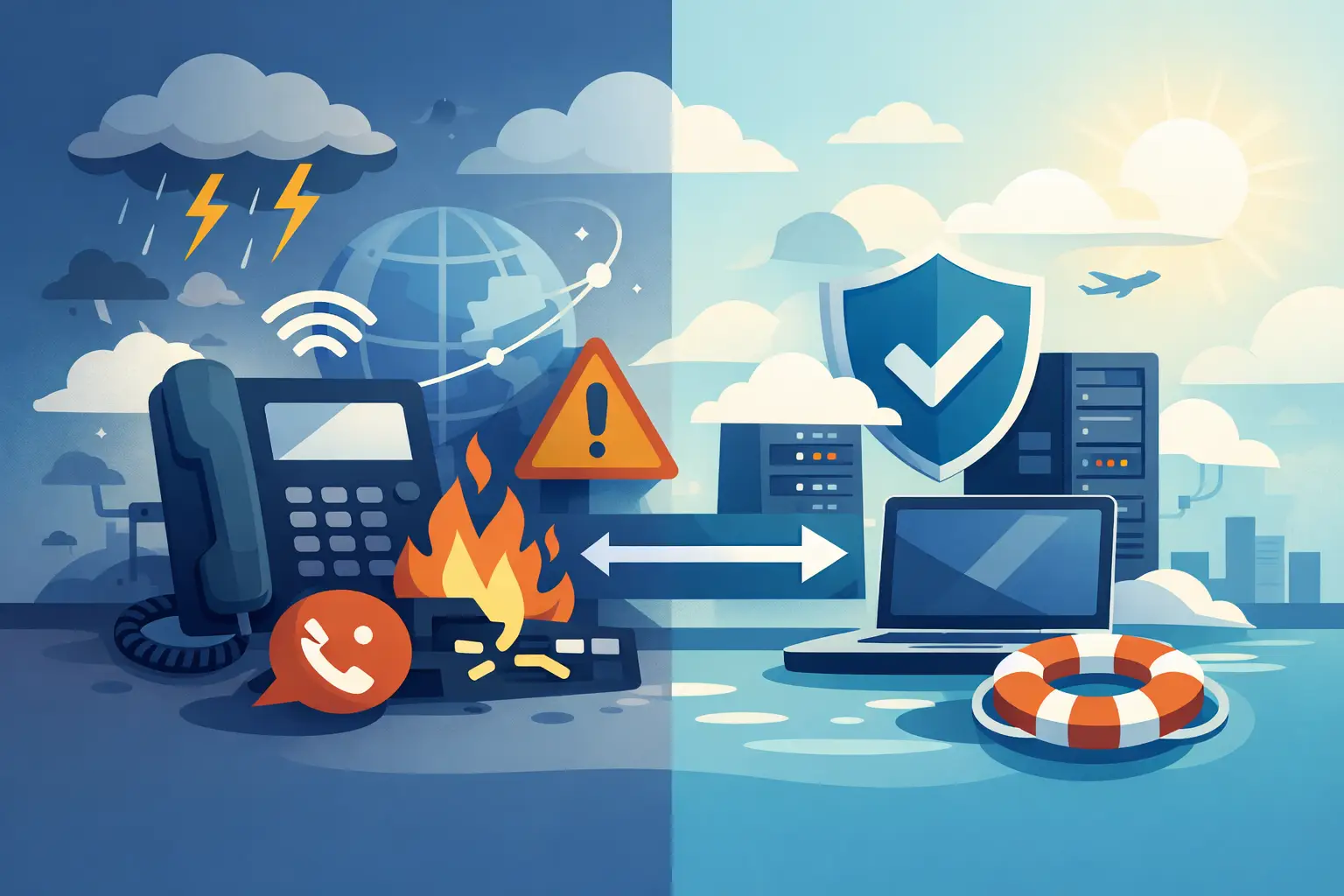
A phone outage rarely starts as a phone problem. It starts with a circuit failure, a power event, a cyber incident, a routing error, or a building that suddenly cannot be used. By the time users report that calls are failing, the real issue is already affecting operations. That is why a voip disaster recovery plan matters. It gives your organization a defined way to preserve voice service, protect call flow, and keep critical communications available when normal conditions break down.
For commercial organizations, school systems, and public-sector teams, the stakes are higher than missed calls. A disruption can delay customer support, interrupt emergency notifications, block internal coordination, and create compliance exposure if call handling falls outside approved systems. A recovery plan for voice should not sit apart from IT continuity planning. It should be integrated into it, with clear ownership, tested procedures, and recovery targets that match the business impact of downtime.
What a voip disaster recovery plan actually covers
A strong voip disaster recovery plan is not just a backup internet connection or a promise that the provider has redundancy. Those things matter, but they do not answer the operational question: how will your organization continue making and receiving calls if one or more dependencies fail?
Voice continuity depends on several layers working together. Your carrier path has to be available. Your call routing has to send traffic to the right destinations. Your users need reachable endpoints, whether that means desk phones, softphones, mobile clients, or redirected numbers. Authentication and security controls must still function. If you operate in a regulated environment, the recovery path also needs to meet the same compliance requirements as normal service.
That means the plan should address more than a full-site disaster. It should cover localized network outages, ISP failures, PBX platform issues, power loss, cyber events, and staffing disruptions. In practice, many organizations are more likely to face a partial failure than a complete shutdown. The quality of your plan depends on how well it handles both.
Start with business impact, not technology
The most common mistake is designing recovery around infrastructure diagrams instead of operational priorities. If every call path is treated as equally important, the plan becomes too broad to execute well.
Start by identifying which communications functions cannot go down without causing material harm. For some organizations, that means inbound main number coverage and contact center queues. For a school district, it may include school office numbers, transportation lines, and emergency notification support. For a government contractor, it may include secure voice access for specific teams or locations operating within controlled environments.
From there, define realistic recovery objectives. How long can each service be unavailable before the impact becomes unacceptable? How much call disruption can your teams tolerate? It depends on the function. Executive calling may wait. Public-facing support lines often cannot. If your organization handles regulated workflows, the acceptable downtime may be shorter, but the approved recovery options may also be narrower.
This is where many cloud voice deployments reveal a gap. They improve flexibility, but flexibility alone is not a recovery strategy. If users can theoretically work from anywhere, that only helps if licensing, device setup, authentication, user training, and routing policies are already in place.
The core components of a workable plan
Every voip disaster recovery plan should define failover paths for connectivity, call routing, endpoints, administration, and support responsibility. The details vary by environment, but the structure should be unambiguous.
Connectivity is the first layer. If your primary internet circuit fails, what carries voice traffic next? A secondary ISP, private connectivity, cellular backup, or alternate site may all be appropriate depending on the location and risk profile. The trade-off is cost versus resilience. A branch office may justify a simpler backup path than a headquarters site or a public safety-adjacent operation.
Call routing is the second layer. If a site becomes unreachable, incoming calls should automatically redirect to another destination. That destination might be a secondary office, a remote user group, an auto attendant with revised options, or mobile endpoints. The key is preconfiguration. During an outage, manual routing changes can work, but they are slower and more error-prone, especially if the people who normally manage telephony are unavailable.
Endpoints are the third layer. If desk phones lose power or local network access, users still need a way to place and receive calls. Softphone clients and mobile applications are often the fastest path to continuity, but only if they have been deployed and tested in advance. If the first time users open the app is during an outage, adoption will slow recovery.
Administrative access matters more than many teams expect. If your voice administrators cannot reach the management portal, cannot authenticate, or do not know who has authority to approve changes, recovery stalls. Good plans define named roles, backup contacts, access methods, and escalation procedures. This is especially important in public-sector and regulated settings, where change control and security boundaries are tighter.
Security and compliance cannot be afterthoughts
A voice outage creates pressure to route around controls. That is where risk enters. Teams start forwarding calls to personal devices, using unapproved apps, or moving sensitive conversations onto consumer platforms. Operationally, that may feel practical in the moment. From a compliance standpoint, it can create a second incident on top of the first.
A recovery plan should specify which fallback methods are approved, which users can use them, and what data handling rules still apply. If your organization operates under CMMC, FedRAMP, or GCC High-related requirements, the recovery architecture needs to support those obligations rather than suspend them. That may influence carrier selection, endpoint policy, call recording rules, and administrative separation.
The right provider architecture makes a difference here. Built-in redundancy is useful, but in regulated environments, resilience has to coexist with secure design. That includes how traffic is segmented, how users authenticate, how failover is logged, and how support processes are governed when an incident is active.
Testing is where most plans succeed or fail
A voip disaster recovery plan that has never been tested is a draft, not a control. The issue is not whether failover exists on paper. The issue is whether your users, administrators, and provider can execute it under pressure.
Testing should be scenario-based. Simulate a site internet outage. Simulate a carrier routing issue. Simulate a power loss affecting desk phones but not mobile endpoints. Simulate a case where key administrators are unavailable. Each test should answer practical questions: did calls reroute as expected, did staff know how to work, were compliance controls maintained, and how long did restoration actually take?
There is a balance to strike. Full live failover exercises provide the best validation, but they can be disruptive. Tabletop exercises are easier to run, yet they can miss configuration problems. Most organizations need both. Start with tabletop reviews to confirm roles and assumptions, then validate critical call flows in controlled technical tests.
Documentation should improve after every exercise. If the plan only lives in the heads of a few IT staff members, it will not hold up when conditions are chaotic. The process needs version control, contact lists, trigger conditions, fallback procedures, and clear criteria for returning to normal operations.
Provider alignment matters more than features alone
When organizations evaluate voice services, they often compare price, calling features, and contract terms first. Those are valid considerations, but disaster recovery depends heavily on provider responsiveness and architectural fit.
Ask practical questions. How is failover handled when a site is unreachable? What routing changes can be automated? What support is available during an incident? How are redundant paths designed? If your environment has compliance requirements, can recovery workflows stay inside those boundaries? A lower-cost service can become expensive quickly if outage handling is slow, manual, or dependent on unsupported workarounds.
For organizations with distributed operations, a consultative provider can help align recovery design to real-world usage patterns. A headquarters office, a contact center, a school campus, and a field workforce do not all need the same failover model. Intuity, for example, works with organizations that need cloud voice resilience tied closely to security, compliance, and operational continuity rather than treated as an add-on feature.
Build for the outage you are most likely to have
It is easy to focus on extreme events, but many outages are smaller and more frequent. A misconfigured router, a failed firmware update, a local power issue, or an ISP cut can be just as disruptive to voice service as a larger regional event. Your plan should reflect the incidents your organization is statistically more likely to face, while still accounting for severe disruption.
That usually means designing layered continuity instead of a single dramatic fallback. Automatic rerouting, alternate user endpoints, secondary connectivity, secure remote access, and tested admin procedures together provide more practical protection than any one feature alone.
The best time to build a voip disaster recovery plan is before your users need it. The best version is one your teams can actually execute, one that preserves both uptime and control, and one that treats communications as essential infrastructure rather than a utility you only notice when it breaks. When voice continuity is planned with the same discipline as security and network availability, recovery becomes faster, cleaner, and far less costly. For a customized proposal tailored to your unique business case, call the experts at Intuity at 800 811-1086.