A single failed analog line can stop an elevator emergency phone, a school front office, a dispatch desk, or a customer service queue. Yet many organizations still manage voice service through a mix of aging PBX equipment, PRI circuits, standalone POTS lines, and disconnected vendor contracts. Cloud telephony gives IT and operations leaders a practical way to replace that complexity with centrally managed calling that can scale, recover, and adapt.
For commercial organizations, schools, and public-sector teams, the value is not simply that phone calls move over an IP network. The real value is greater control over uptime, security, cost, and service continuity. A well-designed deployment can support hybrid employees, preserve critical calling during site changes, and reduce the operational burden of maintaining legacy voice infrastructure.
What Is Cloud Telephony?
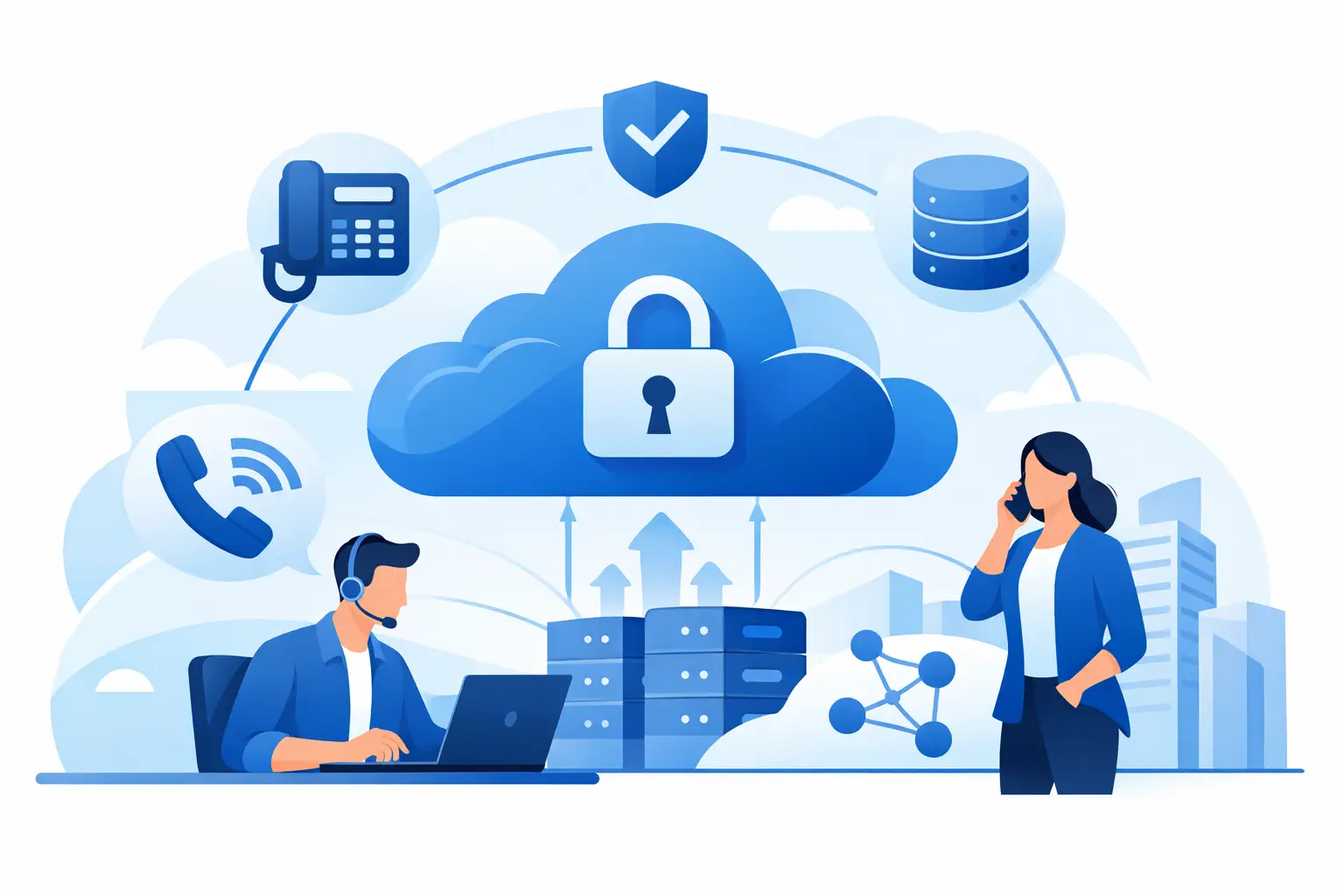
Cloud telephony delivers business voice services through provider-hosted infrastructure rather than on-premises phone hardware and traditional local circuits. Users can place and receive calls through desk phones, softphones, mobile applications, contact center tools, or collaboration platforms, while the provider manages core call routing and service delivery.
This model does not mean every organization needs to replace every phone overnight. Some environments retain existing phone systems and add SIP trunking for a more flexible connection to the public telephone network. Others move fully to hosted VoIP. The right approach depends on the age of the current system, the number of locations, network readiness, compliance requirements, and the business functions that rely on voice.
For example, a multi-site manufacturer may need to retain specialized paging and intercom equipment while modernizing employee calling. A government contractor using Microsoft GCC High may require PSTN connectivity designed for its security environment. A school district may need a phased plan that accounts for main office phones, emergency locations, analog devices, and summer implementation windows.
Why Organizations Are Replacing Legacy Voice
Legacy telephone systems were built for a more fixed workplace. Lines terminated at a building, extensions were tied to a desk, and adding capacity could require new hardware, carrier scheduling, and separate contracts. That model becomes costly and difficult to manage when offices expand, staff work remotely, or critical operations need to continue during a facility outage.
Cloud-based voice infrastructure changes the administration model. Authorized administrators can manage users, call flows, auto attendants, routing rules, and number assignments from a centralized platform. New employees can receive an extension without waiting for physical circuits, and calls can be redirected if an office loses power or connectivity.
Cost control is another reason for migration. Organizations may reduce spending tied to unused lines, hardware maintenance, long-distance billing structures, and repeated service calls. Savings vary widely, however. A low per-user price is not meaningful if it excludes implementation support, emergency calling configuration, number porting, redundancy options, or the features required by the organization. The useful comparison is total operating cost over time, not the monthly seat price alone.
Cloud Telephony Depends on Network Design
Voice quality is often blamed on a phone service when the underlying network is the real issue. A cloud deployment needs sufficient bandwidth, but bandwidth is only part of the picture. Latency, jitter, packet loss, Wi-Fi coverage, firewall settings, and internet-provider resilience all affect call performance.
A business with a small office and dependable fiber may operate well with a straightforward configuration. A call-heavy operation, healthcare-adjacent organization, school district, or public agency may need a more deliberate design, including quality-of-service policies, traffic segmentation, secondary connectivity, and failover routing.
Emergency calling deserves the same level of planning. Cloud systems can support location-aware emergency services, but accurate configuration is essential. If personnel work from multiple sites or home offices, the organization needs clear processes for maintaining location records and understanding how emergency calls are handled. This is an operational responsibility, not a checkbox completed at purchase.
Reliability Is More Than an Uptime Claim
Providers often cite uptime targets, but resilience should be examined across the full calling path. Ask what happens if the primary internet circuit fails, the office loses power, a device is unavailable, or a local site must close unexpectedly. Call forwarding to mobile devices, alternate locations, and predefined emergency routing can keep communications available when a physical office cannot operate normally.
Redundancy also has limits. Forwarding calls to mobile phones may preserve inbound communication, but it may not support every feature, recording policy, or caller experience required by the business. Critical departments should identify their minimum acceptable service level before an outage occurs.
Security and Compliance Require a Different Standard
For many organizations, cloud telephony is evaluated as a productivity tool. In regulated environments, it must also be evaluated as part of the security and compliance posture. Government agencies, contractors, educational institutions, and businesses handling sensitive information need to understand where voice services connect, how administration is protected, and which responsibilities belong to the provider versus the customer.
Security controls should include strong identity and access management, role-based administrative permissions, encrypted signaling and media where appropriate, monitoring, and defined incident-response processes. A secure service also requires disciplined internal practices. Shared administrator accounts, poorly managed credentials, and unmanaged endpoints can weaken an otherwise well-designed platform.
Compliance requirements are not interchangeable. A provider that meets the needs of a standard commercial deployment may not be the right fit for an organization operating in a FedRAMP-authorized environment or requiring GCC High PSTN connectivity. Decision-makers should verify the specific service architecture, authorization scope, documentation, support model, and contractual requirements that apply to their use case.
Questions to Ask Before Selecting a Provider
A productive provider discussion should move beyond feature lists. Ask how the service supports your actual operating conditions:
- Can the platform integrate with current PBX equipment, collaboration tools, and specialized devices during a phased migration?
- What redundancy exists at the provider level, and what failover options are available at each customer site?
- How are number porting, emergency calling locations, and after-hours routing handled during implementation?
- What security, compliance, and administrative controls are included, and which are the customer’s responsibility?
- Is support US-based, and who owns escalation when a critical calling issue affects operations?
The answers reveal whether a provider is selling a commodity phone service or designing communications infrastructure around the organization’s risks and requirements.
Planning a Cloud Telephony Migration
A successful migration starts with an inventory, not a product demo. Identify every number, circuit, extension, call queue, fax line, alarm panel, elevator phone, door entry device, paging system, and application that depends on voice connectivity. Legacy lines often support functions that are easy to overlook until they fail.
Next, document call flows. Determine how customers, parents, vendors, citizens, and employees reach each department. Identify peak calling periods, escalation paths, holiday schedules, remote-work needs, and the lines that cannot tolerate downtime. This information shapes the design of auto attendants, queues, routing policies, and failover plans.
Then assess the network and implementation sequence. A phased cutover can reduce risk for organizations with multiple locations or complex analog dependencies. Pilot a representative site or department, validate call quality and emergency calling, train administrators and users, and establish a clear support process before expanding. Number porting should be coordinated carefully so that service remains active until the transfer is complete.
Training matters even when the technology is familiar. Employees need to know how to transfer calls, use voicemail, update availability, reach emergency services, and work through a local outage. Administrators need documented procedures for onboarding, offboarding, permission changes, and service requests. The platform is only as dependable as the processes around it.
When Cloud Telephony Is Not a Simple Replacement
Cloud telephony is a strong fit for many organizations, but not every voice endpoint should be treated the same way. Analog systems may remain necessary during a transition, particularly for life-safety devices, legacy fax workflows, building access, or specialized equipment. In these cases, POTS replacement or purpose-built adapters may be needed, with testing that confirms compatibility and reliability.
Organizations with weak or highly variable internet service may also need to invest in connectivity before moving call-critical functions. The cloud model can improve flexibility, but it cannot eliminate the need for a dependable network path. A consultative provider will identify those constraints early rather than promise a one-size-fits-all migration.
The strongest cloud telephony strategy is built around the calls your organization cannot afford to miss. Start with those dependencies, validate the network and compliance requirements, and choose a service design that supports continuity long after the first phones are installed.