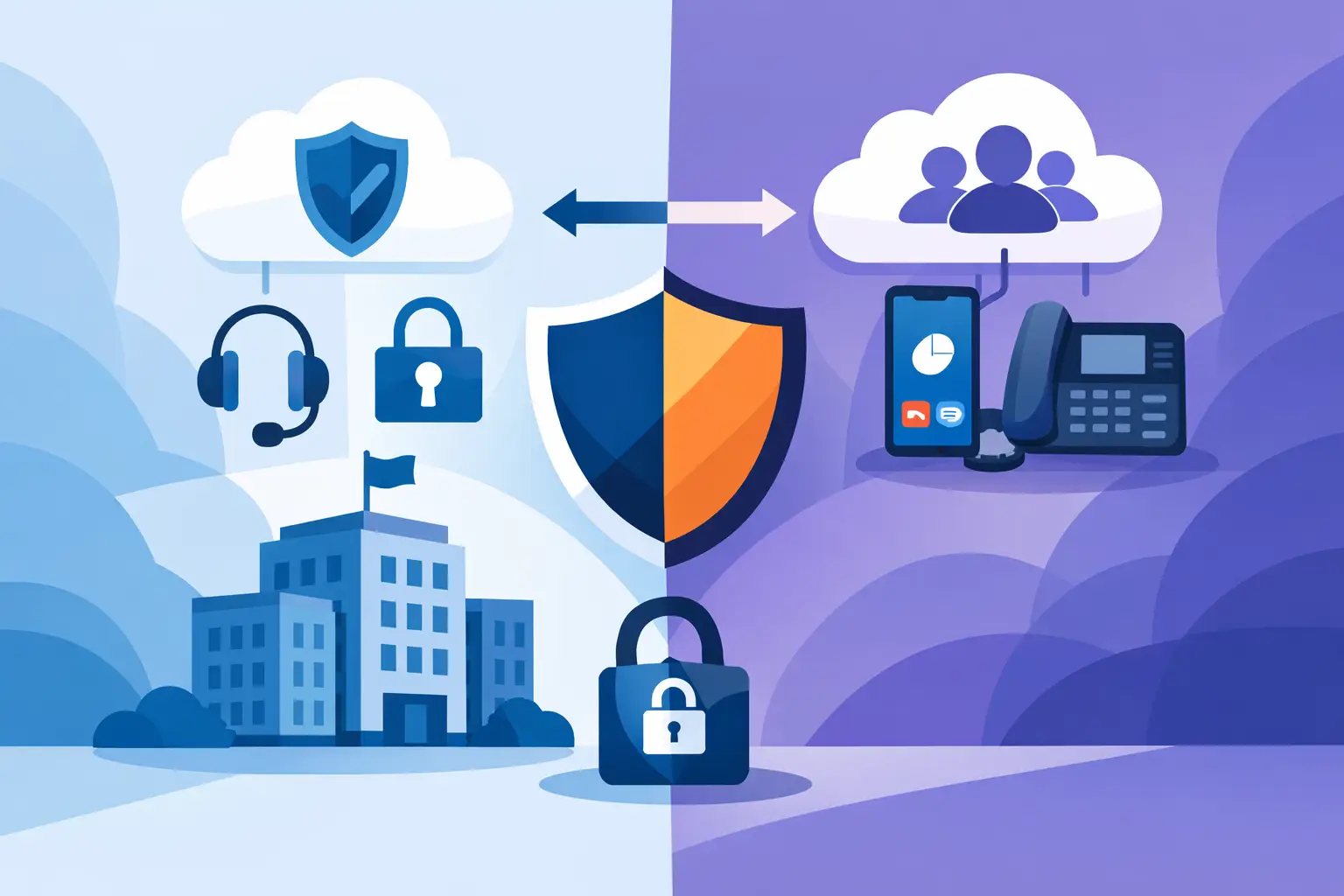
A government contractor can have Teams deployed, users trained, and collaboration policies in place, then discover that placing compliant external calls requires a separate design decision. That is the issue behind GCC High vs Teams Phone: these are related Microsoft communications capabilities, but they are not competing products in the usual sense.
GCC High is a specialized Microsoft 365 cloud environment built for organizations handling controlled unclassified information and meeting stringent federal security requirements. Teams Phone is Microsoft’s cloud-based calling capability. An organization may use Teams Phone within GCC High, but its PSTN connectivity, licensing, emergency calling, call routing, and support model must be planned for that environment.
For IT leaders, procurement teams, and systems integrators, the practical question is not which one to buy. It is how to build a voice service that preserves the compliance boundary while delivering dependable calling to employees, customers, agencies, and partners.
GCC High vs Teams Phone: Why the Comparison Matters
Teams Phone adds enterprise telephony functions to Microsoft Teams. It provides calling policies, number assignment, call queues, auto attendants, voicemail, transfer, delegation, and other features traditionally handled by a PBX. By itself, however, Teams Phone does not automatically provide the public telephone network connection required to make and receive external calls.
GCC High is the Microsoft cloud environment used by many defense contractors, government agencies, and organizations with requirements tied to CMMC, ITAR, DFARS, or similar obligations. Its purpose is to support more demanding security and compliance needs than Microsoft’s commercial cloud.
This distinction affects the buying and architecture process. A commercial organization may select a Teams Phone license and a standard calling option with relatively few dependencies. A GCC High organization must verify that every voice component supports its required environment and operating model. Assuming that a commercial Teams calling design will transfer directly to GCC High can create delays, unsupported configurations, or compliance exposure.
The stakes are operational as well as regulatory. Voice services still support emergency response, service desks, customer contact, field operations, secure facilities, and executive communications. If a calling deployment is not engineered for resiliency and supportability, the organization can lose more than convenience when an outage occurs.
What GCC High Changes for Voice Deployment
The core Teams calling experience may look familiar to users in GCC High. They can place calls through the Teams client, receive assigned numbers, access call queues, and work from approved devices. The difference is largely behind the scenes: the available service options, interoperability requirements, and compliance responsibilities are more constrained.
PSTN connectivity requires deliberate selection
Teams Phone needs a path to the PSTN. In a commercial Microsoft tenant, organizations may have access to options that are not available, not appropriate, or not approved for their GCC High deployment. Direct Routing is often the preferred model for organizations that need control over their carrier, call routing, survivability strategy, and compliance posture.
With Direct Routing, a certified session border controller connects Teams to a qualified voice carrier through SIP trunking. This model enables organizations to retain or port phone numbers, establish routing rules, connect existing analog or legacy systems when needed, and design redundancy across sites or network paths.
The provider selection matters. The carrier must understand GCC High PSTN connectivity and the technical requirements of the deployment. A low-cost SIP service without relevant experience can leave the internal team to resolve number porting, certificate management, emergency-location design, and escalations across several vendors.
Security is more than the tenant boundary
GCC High helps establish an appropriate Microsoft cloud boundary, but voice architecture remains a shared responsibility. Organizations still need to evaluate how calls enter and leave the environment, where session border controllers reside, how administrators access systems, how call records are handled, and what controls apply to connected devices.
For regulated organizations, this review should include vendor operations and support practices. Ask whether support personnel are US-based when that requirement applies, how incidents are escalated, what access controls are used, and whether the provider can document its role in the overall security architecture. The right answers depend on the contract and agency requirements, but they should be confirmed before deployment rather than after a security review identifies a gap.
Emergency calling needs location accuracy
E911 planning is not a license checkbox. Hybrid employees, branch offices, secure campuses, and remote workers can all affect how emergency locations are assigned and updated. Teams Phone deployments should define who owns location data, how changes are validated, what happens when a user moves between locations, and how emergency calls route during a network disruption.
Organizations with multiple facilities should also test emergency calling in real operating conditions. A configuration that appears correct in an administrative portal may not account for a new office suite, a shared workspace, or a user connecting through a home network.
When Teams Phone in GCC High Is the Right Fit
Teams Phone in GCC High is a strong fit when an organization needs Microsoft-based collaboration and enterprise calling without moving sensitive workloads into a commercial tenant. It can reduce the management burden of separate chat, meeting, and desk-phone platforms while supporting a distributed workforce.
It is especially useful when the organization needs centralized policy management. IT teams can standardize calling features across headquarters, remote employees, and satellite offices, while using Direct Routing to apply routing rules that reflect operational needs. For example, a contractor may route customer calls through a main auto attendant, maintain local numbers for regional offices, and provide failover treatment for critical lines.
However, cloud calling is not always a complete replacement for every voice requirement. Elevators, fire panels, fax machines, alarms, paging systems, and other analog endpoints may require POTS replacement, analog gateways, or dedicated connectivity. A successful migration identifies these dependencies early instead of treating them as exceptions after the primary phone system is cut over.
Questions to Ask Before Choosing a Calling Model
A productive evaluation starts with the environment rather than the feature list. Confirm whether the tenant is GCC High, whether the organization expects to move there, and which compliance obligations affect communications services. Then determine how users actually make and receive calls: from Teams clients, desk phones, contact centers, shared devices, or a combination of these.
Next, assess the current carrier and number inventory. Many organizations have accumulated local numbers, toll-free lines, PRIs, analog circuits, and specialty services over years of acquisitions or site changes. Porting and consolidation can reduce cost, but only when each number has a documented owner, purpose, and routing plan.
Finally, define the resilience requirement. A small office may accept temporary mobile-phone fallback. A public agency, school district, healthcare-adjacent operation, or customer service team may need more deliberate continuity measures, such as redundant SIP trunking, alternate call routing, and local survivability options. The appropriate design depends on the consequence of lost calling, not simply on the number of users.
A Practical Deployment Path
The most dependable deployments begin with a voice discovery process. Inventory every number, endpoint, carrier circuit, call flow, emergency location, and integration. This produces a migration plan that can separate simple user calling from specialized lines that need a different solution.
After discovery, the technical team should validate the GCC High tenant configuration, Teams Phone licensing, Direct Routing design, session border controller requirements, and network readiness. Quality of service remains essential. Internet bandwidth alone does not guarantee call quality if the network cannot prioritize voice traffic or if remote users have unstable connections.
Testing should include more than internal calling. Validate inbound and outbound PSTN calls, transfer scenarios, call queues, voicemail, toll-free numbers, emergency dialing, failover behavior, and number porting. Pilot groups are useful, particularly when they include reception, operations, remote employees, and leaders who rely on delegated calling.
A consultative provider can simplify this process by coordinating the carrier, Microsoft environment, SBC configuration, and cutover plan. Intuity helps organizations design secure GCC High PSTN connectivity around their specific compliance, continuity, and migration requirements rather than forcing a one-size-fits-all voice package.
The best next step is to map your compliance boundary and call flows before selecting a PSTN option. That work turns a confusing product comparison into a voice architecture that users can rely on when the call matters.