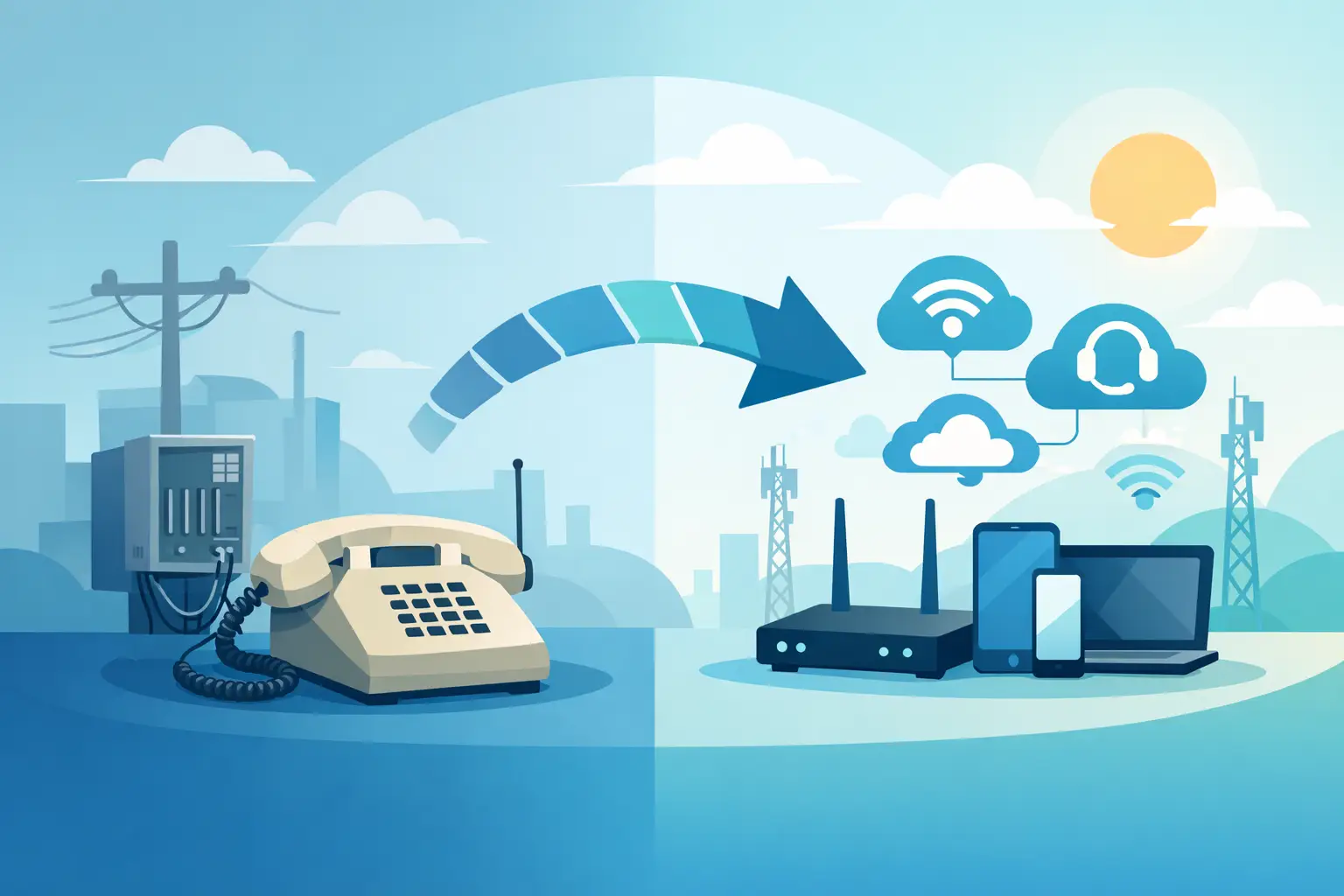
A fire alarm panel, elevator phone, emergency call box, or building access controller may use only a single analog line, but its failure can create an immediate operational and safety problem. That is why POTS replacement should not be treated as a routine phone-system upgrade. It is a continuity project for the services that organizations often discover only when a line stops working or a carrier announces another rate increase.
For IT and operations leaders, the objective is straightforward: replace aging copper-based Plain Old Telephone Service connections with a managed, monitored alternative that supports critical devices without weakening reliability, security, or compliance. The execution is more involved. Every line has a purpose, every site has different network conditions, and some devices have signaling requirements that a standard voice deployment does not address.
Why POTS Replacement Has Become an Operational Priority
Traditional analog service was built on a copper network that is expensive to maintain and increasingly unavailable in many markets. Carriers have reduced support for legacy infrastructure, raised rates for individual business lines, and encouraged customers to move to newer services. Organizations with dozens or hundreds of analog lines can see costs rise even as the quality of support declines.
The cost issue is real, but it is rarely the only reason to act. Analog lines are often distributed across branch offices, campuses, mechanical rooms, remote facilities, and leased spaces. They can be difficult to inventory, have unclear ownership, and may be billed under old account structures. A line that appears insignificant in a telecom invoice may support a life-safety or revenue-critical device.
A well-designed replacement program gives the organization more control. It creates a documented view of every critical connection, reduces dependence on aging local infrastructure, and establishes a path to centralized management. Cloud-based and cellular-enabled alternatives can also provide better visibility into device status and line activity than traditional copper service.
That does not mean every analog line can be moved using the same method. The best design depends on device type, network availability, power requirements, regulatory obligations, and acceptable outage risk.
Start With the Devices, Not the Carrier Bill
Carrier invoices are useful for finding lines, but they do not explain what those lines do. A migration should begin with a physical and operational inventory that matches each telephone number to a device, location, owner, and business function.
For each line, document whether it supports an elevator, fire or intrusion alarm, fax machine, point-of-sale terminal, emergency phone, gate controller, building system, modem, or a remaining voice endpoint. Record the device manufacturer, model, signaling method, current provider, service address, and any contract or inspection requirements. Include the circuit path when it is known, especially for lines that may run through an on-premises PBX or alarm panel.
This work frequently uncovers surprises. A line listed as “fax” may connect a legacy monitoring device. An unused-looking number may be programmed into a service contract. A single line may be shared by more than one device, creating an outage risk that is not visible from the bill alone.
Assign each device a criticality level. Life-safety systems, emergency communications, and security monitoring generally require the highest level of review. Lines supporting convenience functions may have more flexibility. This distinction helps the project team decide where to invest in redundancy, backup connectivity, and extended testing.
Choose the Right Replacement Architecture
POTS replacement is not one product. It is a set of architectures that can deliver analog-compatible service through modern transport. The correct choice should be based on the device and its operating environment rather than on the lowest monthly price.
Analog Telephone Adapters Over Managed IP
An analog telephone adapter, or ATA, converts an analog device connection to IP-based voice service. This approach can work well where the device is compatible with VoIP signaling and the site has a stable, professionally managed internet connection. It can be cost-effective for ordinary analog endpoints and can support centralized administration.
The trade-off is dependency on the local network and power. If the WAN connection, router, switch, or site power fails, the device may lose service unless the design includes appropriate backup measures. For critical endpoints, evaluate dedicated connectivity, quality-of-service controls, battery backup, and failover routing rather than assuming the existing office network is sufficient.
Cellular-Enabled POTS Alternatives
Cellular-based adapters use wireless networks as the transport layer for analog devices. They are often a practical option for locations where reliable wired internet is unavailable, where deployment must be fast, or where the organization wants an access path independent of its primary WAN.
Cellular service should still be engineered carefully. Signal strength can vary by room and building construction. Antenna placement, carrier coverage, power backup, and environmental conditions matter. A solution that works during a technician’s initial test may not meet the required reliability standard without a site assessment and ongoing monitoring.
Purpose-Built Solutions for Alarms and Life Safety
Fire alarms, burglar alarms, elevator emergency phones, and similar systems deserve a separate design review. These devices may use tone-based signaling, modem protocols, supervised communication paths, or requirements established by an authority having jurisdiction, monitoring company, equipment manufacturer, or local code.
A replacement service must be tested with the receiving center and the actual device, not simply verified by obtaining dial tone. For elevator phones, that can include confirming two-way calling, location identification, and behavior during a power failure. For alarm panels, it can include confirming successful transmission, supervision, and reporting under the required test conditions.
Build Reliability Into the Migration Plan
The strongest POTS replacement projects treat uptime as an architecture decision, not a promise on a proposal. Determine what must remain operational during a local power outage, an internet outage, a carrier incident, or a building access problem. Then design the service around those scenarios.
Power is a common gap. Legacy copper lines often provided limited line power, while modern adapters require local electricity. A battery backup may be adequate for a low-risk device, but critical systems may need longer runtime, monitored power equipment, or a documented emergency power strategy. The same analysis applies to network components supporting IP-based adapters.
Redundancy should be proportional to risk. A noncritical lobby phone may be suitable for a single connection. An emergency communications device may require independent primary and backup paths, such as managed IP with cellular failover. There is no universal answer, but there should be a documented reason for the design selected.
Number porting also requires planning. Retaining existing numbers can be essential for elevator dispatch, alarm monitoring, published emergency contacts, and vendor records. Keep the current service active until porting is complete and acceptance testing has passed. Disconnecting legacy lines too early is one of the easiest ways to turn a controlled migration into an avoidable outage.
Address Security and Compliance From the Beginning
For government agencies, contractors, school systems, healthcare-adjacent environments, and other regulated organizations, voice connectivity is part of the broader security posture. The migration plan should identify how devices, gateways, management portals, and transport connections are authenticated, monitored, and supported.
Ask whether the provider can align service design with your environment’s requirements, particularly when communications must operate within strict compliance boundaries. Organizations using GCC High or supporting CMMC and FedRAMP-related programs should evaluate service architecture, administrative access, support processes, data handling, and escalation procedures before deployment. A low-cost analog replacement that creates an unmanaged exception can introduce more risk than it removes.
Operational ownership matters as much as technical controls. Establish who receives outage alerts, who can make configuration changes, how emergency changes are approved, and how device inventories will stay current. This is especially valuable for distributed organizations where facilities, security, IT, and outside vendors all touch the same line.
Test in Phases, Then Document the New Standard
A pilot at one or two representative sites allows the organization to validate device compatibility, signal quality, failover behavior, and support responsiveness before a broad rollout. Choose pilot locations that expose real conditions, such as a remote facility, a large campus building, or a site with life-safety equipment. The easiest office is rarely the most useful test case.
During acceptance testing, verify outbound and inbound calling where applicable, device-specific signaling, power-loss behavior, backup-path operation, monitoring notifications, and escalation contacts. Capture results in a standard record that can be used across the remaining sites. This creates consistency without forcing every location into an identical design.
After cutover, update diagrams, vendor contacts, device labels, and emergency procedures. Review the service periodically, particularly after building renovations, network changes, equipment replacement, or changes to monitoring vendors. A modern solution is easier to manage than legacy copper, but only if the organization maintains the documentation that gives it context.
A consultative provider can make this process more manageable by combining discovery, solution design, porting coordination, testing, and ongoing support under one accountable service model. Intuity helps organizations evaluate critical analog dependencies and build replacement plans that match their reliability and compliance needs.
The right time to begin is before a carrier-driven change, a failed copper line, or an inspection exposes an undocumented dependency. Start by identifying what each analog line protects or enables, then build a replacement design that keeps those functions available when they are needed most.