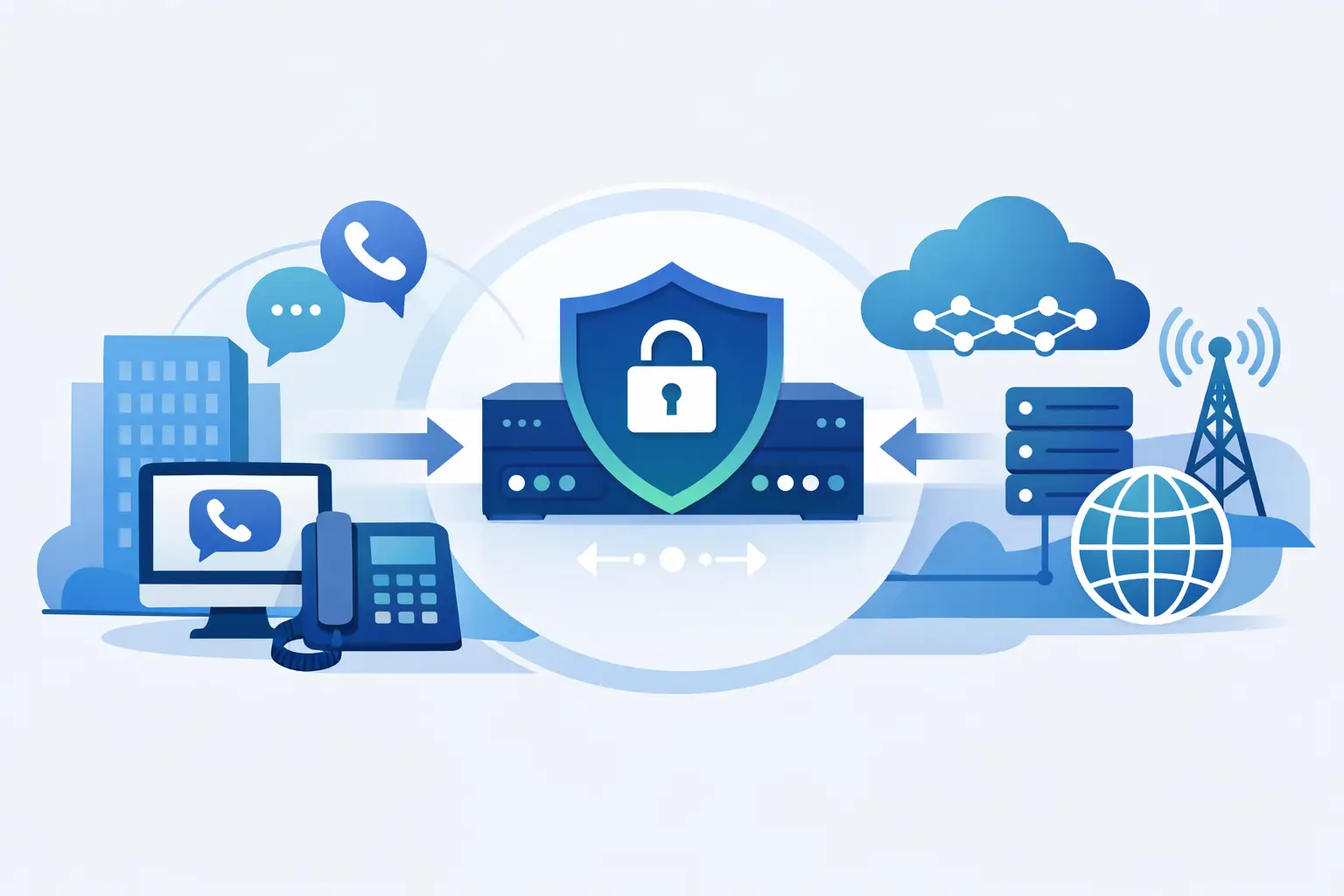
A SIP trunk can lower telecom costs quickly. It can also expose weak points in your voice environment just as quickly. If your organization is moving off PRI, consolidating locations, or supporting remote users, an SBC for SIP trunking often becomes the control point that determines whether the transition is stable and secure – or difficult to manage.
For IT leaders and operations teams, this is not just a technical add-on. It is the boundary between your internal voice infrastructure and the outside carrier network. That boundary matters when you need predictable call quality, survivability during outages, and policy enforcement that stands up to security reviews.
What an SBC for SIP trunking actually does
A session border controller sits at the edge of the voice network and manages SIP signaling and media sessions between systems. In practical terms, it governs how calls are set up, how audio flows, and which traffic is permitted to enter or leave the environment.
That sounds simple, but the value is in the control it provides. SIP trunking connects your phone system, UC platform, or contact center to a service provider over IP. Without an SBC, that connection can be harder to secure, harder to normalize, and harder to troubleshoot when interoperability issues appear.
An SBC for SIP trunking commonly handles traffic inspection, topology hiding, encryption support, protocol normalization, call admission control, and failover logic. It can also mediate between different vendors that each interpret SIP a little differently. Anyone who has worked through one-way audio, failed transfers, broken caller ID, or inconsistent codec negotiation knows that those differences are not theoretical.
Why enterprises deploy an SBC for SIP trunking
Security is usually the first reason. A SIP trunk should not be treated like a basic internet service. Voice traffic is a target for toll fraud, denial-of-service attempts, malformed SIP messages, and unauthorized access attempts. An SBC helps by filtering and validating traffic before it reaches your communications platform.
For regulated organizations, that security role has operational consequences. Schools, healthcare organizations, public agencies, and government contractors often need tighter control over how communications are routed and protected. In those cases, the SBC is part of a broader architecture decision tied to compliance, segmentation, and risk reduction.
The second reason is interoperability. SIP is a standard, but implementations vary across carriers, PBXs, Teams integrations, and UC platforms. An SBC can normalize signaling so that one side does not need to match the other perfectly. That reduces deployment friction and helps preserve flexibility when you are not using a single-vendor environment.
The third reason is resilience. If your organization depends on voice for customer support, safety notifications, admissions, dispatch, or interoffice coordination, downtime is expensive. An SBC can support routing policies that shift traffic during a carrier problem, redirect calls during an outage, or maintain service continuity across multiple sites.
Security benefits beyond the firewall
Many organizations assume the firewall already covers voice security. It helps, but it is not designed to manage SIP and RTP with the same depth as a purpose-built SBC. Firewalls are good at broad traffic control. SBCs are built for session-level voice policy.
That difference shows up in real deployments. SIP opens dynamic media paths, negotiates ports, and relies on signaling behavior that standard security tools may not interpret cleanly. An SBC can inspect these sessions in context, reject malformed traffic, limit suspicious call patterns, and protect internal IP addressing from external exposure.
Encryption is another consideration. If your organization needs TLS for signaling and SRTP for media, the SBC can act as the enforcement point. It can also help manage secure interconnection when the carrier, platform, and internal systems have different capabilities or requirements.
None of this means every deployment needs the same level of complexity. A smaller business with a single site and straightforward SIP service may need a lighter configuration than a public-sector agency with segmented networks and strict continuity requirements. The key point is that voice security needs voice-aware controls.
Call quality and performance control
Call quality issues rarely come from one source. They usually come from the interaction between bandwidth, codecs, jitter, packet loss, routing decisions, and endpoint behavior. An SBC does not replace good network design, but it gives your team more control over how voice sessions are handled.
It can enforce codec policies, limit oversubscription, and apply call admission control so the network does not accept more concurrent sessions than it can support. That matters at headquarters, branch offices, and remote sites where data and voice share the same WAN paths.
The SBC also provides visibility. When users report choppy audio or dropped calls, troubleshooting is much easier when there is a central point monitoring signaling and media. Instead of guessing whether the problem sits with the carrier, the PBX, the internet connection, or a routing policy, your team has a clearer record of what happened during the session.
Where SBCs fit in cloud and hybrid voice environments
The shift to cloud communications has not made SBCs irrelevant. In many cases, it has made their role more strategic.
If you are connecting on-premises systems to cloud calling, integrating Microsoft environments with PSTN access, or running a phased migration from legacy telephony, the SBC often becomes the translation and control layer that keeps the project manageable. It can bridge old and new systems while preserving dial plans, number routing, and business continuity.
This is especially important in hybrid environments. Many organizations are not moving everything at once. They may keep a legacy PBX in one facility, deploy cloud calling to remote users, and centralize SIP trunking across locations. An SBC helps make that mixed environment behave like a coherent service instead of a collection of exceptions.
For organizations operating in regulated or government-adjacent environments, the architecture matters even more. Security boundaries, approved connectivity paths, and continuity planning all need to be considered early. A provider with experience in compliant voice design can help determine whether the SBC should be customer-managed, provider-managed, virtualized, or deployed in a high-availability pair.
Choosing the right SBC approach
There is no single best SBC model for every organization. The right choice depends on call volume, platform mix, compliance obligations, geographic footprint, and whether you want direct operational control or a managed service.
A dedicated physical appliance may make sense for larger sites with strict local control requirements. A virtual SBC can be a better fit for distributed environments or cloud-first strategies. Some organizations prefer a fully managed SBC service because it reduces internal administration and gives them a clearer support path when issues arise.
Trade-offs matter here. More control can mean more configuration responsibility. A lower-cost option may meet basic connectivity needs but leave gaps in visibility or failover design. A deployment that works for a standard commercial office may not satisfy a school district, a municipality, or a contractor handling controlled information.
When evaluating options, decision-makers should look beyond box-level specifications. The more useful questions are operational. How will failover work? Who owns policy changes? How will security events be monitored? What happens during a carrier outage? How will the SBC support growth, remote locations, or future UC migrations?
Common signs you should not skip the SBC
Some organizations can technically connect SIP service without an SBC, but that does not always mean they should. If you have multiple sites, multiple carriers, mixed phone platforms, compliance requirements, or a low tolerance for downtime, the risk of a simpler design tends to rise.
The same is true if your team has already experienced interoperability issues, fraud attempts, quality complaints, or complicated firewall workarounds. Those are often signs that voice traffic needs its own control layer.
In consultative deployments, this is where a provider can add real value. The best approach is not to overspecify the environment. It is to align the SBC design with the organization’s actual business risk, technical complexity, and continuity goals. That is the difference between adding infrastructure and solving a communications problem.
For organizations investing in SIP trunking as a long-term platform, the SBC should be viewed less as a technical accessory and more as part of the service foundation. When voice availability, security, and compliance matter, that foundation deserves careful design. If your next telecom decision needs to reduce risk instead of shifting it, that is the right place to start.