A failing copper line usually does not announce itself with much drama. Calls start sounding thin, faxing becomes unreliable, and suddenly a location that has worked the same way for years turns into a service ticket generator. That is often when the real VoIP vs analog lines conversation begins – not as a theory, but as an operational decision with cost, uptime, and security implications.
For organizations responsible for multiple sites, regulated communications, or hybrid workforces, the choice is rarely just about replacing dial tone. It is about whether the phone environment can support the way the business actually operates now. Analog lines still exist for a reason, but their limitations are becoming harder to ignore as carriers retire legacy infrastructure and support models shift toward IP-based services.
VoIP vs analog lines: what is the real difference?
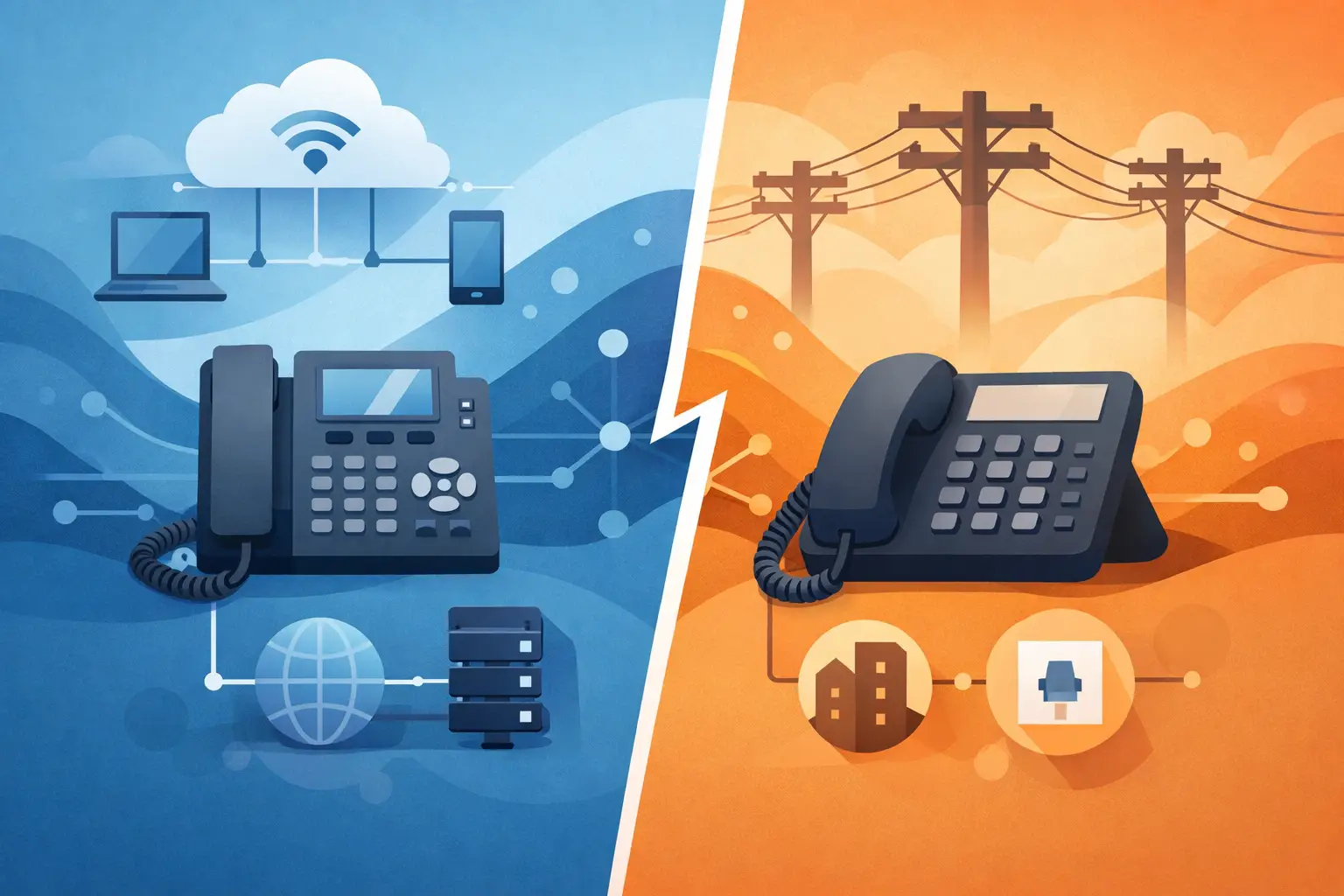
Analog lines use traditional copper-based connections to carry voice as electrical signals over the public switched telephone network. They are familiar, simple, and often tied to older desk phones, alarms, elevators, fax machines, and legacy PBX systems.
VoIP, or Voice over Internet Protocol, converts voice into digital packets and sends them over an internet or private IP connection. In practice, that means calling is no longer limited to a physical line at a specific desk. It can extend across office phones, softphones, mobile devices, and cloud-based routing platforms.
The technical difference matters because it changes how organizations buy, manage, secure, and scale voice services. Analog is line-based. VoIP is network-based. One is built around physical circuits. The other is built around flexible capacity and software-driven control.
Where analog lines still make sense
Analog lines are not obsolete in every scenario. In some environments, they still serve a practical purpose.
Single-purpose endpoints such as elevator phones, alarm panels, and certain fax workflows may continue to rely on analog connectivity, especially when replacement costs or regulatory constraints make immediate migration unrealistic. Small offices with minimal call volume and very basic needs may also keep analog lines for the short term if the existing setup is stable.
There is also a perception that analog is more dependable during outages because it has historically carried its own power. In some cases, that remains true. But that advantage is shrinking as telecom carriers retire copper infrastructure, replace traditional services, or deliver voice through newer equipment that does not behave like legacy analog service once did.
So the question is not whether analog can still work. It is whether it is the right long-term foundation for a business communications strategy.
Why many organizations are moving to VoIP
Most business migrations are driven by a mix of economics, flexibility, and operational control.
VoIP reduces dependence on physical lines. Instead of ordering separate circuits for every user, location, or growth phase, organizations can scale service more efficiently. Adding users, moving offices, supporting remote staff, or adjusting call routing can often be handled through configuration rather than truck rolls and rewiring.
That flexibility matters for distributed teams, school systems, healthcare-adjacent operations, and public-sector environments where staff may work across campuses, offices, or field locations. A modern phone system is no longer just a handset. It is part of how people answer, transfer, route, record, and secure business communications.
Cost is also part of the equation. Analog systems can appear less expensive when viewed line by line, especially if the equipment is already in place. But support costs, maintenance, limited functionality, and carrier pricing for legacy services often shift the total picture. VoIP usually delivers more capability per dollar, particularly for organizations managing multiple numbers, locations, or user groups.
Cost comparison: upfront savings vs long-term value
The VoIP vs analog lines cost discussion can get oversimplified. Analog may look cheaper if you only compare monthly line charges for a very small office. That comparison breaks down quickly in more complex environments.
With analog, each line is tied to a physical service. Growth usually means additional circuits, more hardware constraints, and potentially more vendor coordination. Moves, adds, and changes can take longer and cost more. Older PBX systems may also require specialized support that is increasingly harder to source.
VoIP typically shifts the model toward predictable service plans and centralized management. The financial value comes from easier scaling, less dependence on on-site hardware, and features that would otherwise require separate systems. Auto attendants, hunt groups, call reporting, voicemail to email, remote extensions, and failover routing all contribute to efficiency.
For procurement and IT leaders, the better question is not simply, “Which is cheaper this month?” It is, “Which model gives us lower operational friction and better control over the next three to five years?”
Reliability depends on design, not nostalgia
One reason some organizations hesitate to move away from analog is the belief that old systems are inherently more reliable. That belief is understandable, but it is incomplete.
A properly engineered VoIP environment can deliver excellent reliability. The key is network readiness, bandwidth management, redundancy, and failover planning. If voice is treated as a mission-critical service instead of an afterthought riding on a weak internet connection, performance can be highly dependable.
Analog reliability, meanwhile, is often judged by the memory of how copper service performed years ago. In many areas, that legacy standard no longer reflects current carrier infrastructure or support realities. Repair times, service quality, and equipment compatibility may not match expectations, especially as providers prioritize IP-based networks.
For business continuity, VoIP often provides stronger options. Calls can be rerouted automatically to alternate sites, mobile devices, or backup users during an outage. That kind of resilience is difficult to replicate with a basic analog line model.
Security and compliance are major decision points
For regulated organizations, security is not a feature add-on. It is part of the buying criteria.
Analog lines are sometimes assumed to be safer because they are older and less internet-facing. But older does not automatically mean more secure. Legacy systems can create blind spots around management, auditing, and access control. They are also harder to integrate into a broader communications governance strategy.
VoIP introduces new security considerations, including encryption, session control, network segmentation, authentication, and provider architecture. When those elements are designed well, VoIP can support a much stronger security posture than fragmented legacy telephony. This is particularly relevant for organizations with CMMC, FedRAMP, GCC High, or other compliance requirements where communications environments must align with documented controls and operational standards.
That is why provider selection matters. In regulated environments, the discussion should move beyond basic hosted phone features and into service design, redundancy, support responsiveness, and compliance alignment.
Features are where the gap becomes obvious
The clearest difference in the VoIP vs analog lines debate often appears in day-to-day use.
Analog lines are built for basic calling. They do that job, but not much more. If your organization needs modern call routing, user-level reporting, remote access, CRM integration, centralized administration, or location-based continuity planning, analog becomes restrictive very quickly.
VoIP supports business processes, not just conversations. Calls can follow users instead of desks. Administrators can adjust routing in real time. Teams can maintain continuity during office closures, weather events, or staffing changes. Multi-site organizations can manage communications as one environment instead of stitching together isolated systems.
For schools, public agencies, and commercial operations alike, those capabilities are not just conveniences. They affect response times, service delivery, and staff productivity.
When a hybrid approach is the smart move
Not every organization should move every line at once. In many cases, a hybrid model is the most practical path.
Core business calling may transition to VoIP while a small number of analog lines remain in place for alarms, fax machines, life-safety devices, or specialty equipment. That approach reduces disruption while giving the organization immediate gains in flexibility, reporting, and cost control.
A phased migration also gives IT and operations teams time to assess network readiness, train users, and replace dependencies methodically rather than under pressure. For organizations with multiple sites or compliance constraints, that measured approach often produces better outcomes than an all-at-once cutover.
How to decide which direction fits your organization
The right choice depends on your current infrastructure, risk tolerance, compliance requirements, and growth plans.
If your phone environment is limited to a handful of lines with no mobility needs and no near-term changes, analog may remain serviceable for a while longer. If you are dealing with aging hardware, rising carrier costs, multiple locations, remote users, or stricter security expectations, VoIP is usually the stronger long-term fit.
It also helps to evaluate the hidden cost of staying put. Legacy phone service can create operational drag in ways that do not show up neatly on an invoice. Delayed changes, limited redundancy, poor visibility, and compatibility issues all consume time and increase risk.
A consultative provider can help you separate what must remain analog from what should be modernized now. For organizations that need secure, compliant, cloud-based voice infrastructure, that assessment is often where the biggest savings and reliability gains begin.
The best phone system is not the one that feels familiar. It is the one that keeps your organization reachable, secure, and ready for change without forcing your team to work around the technology.