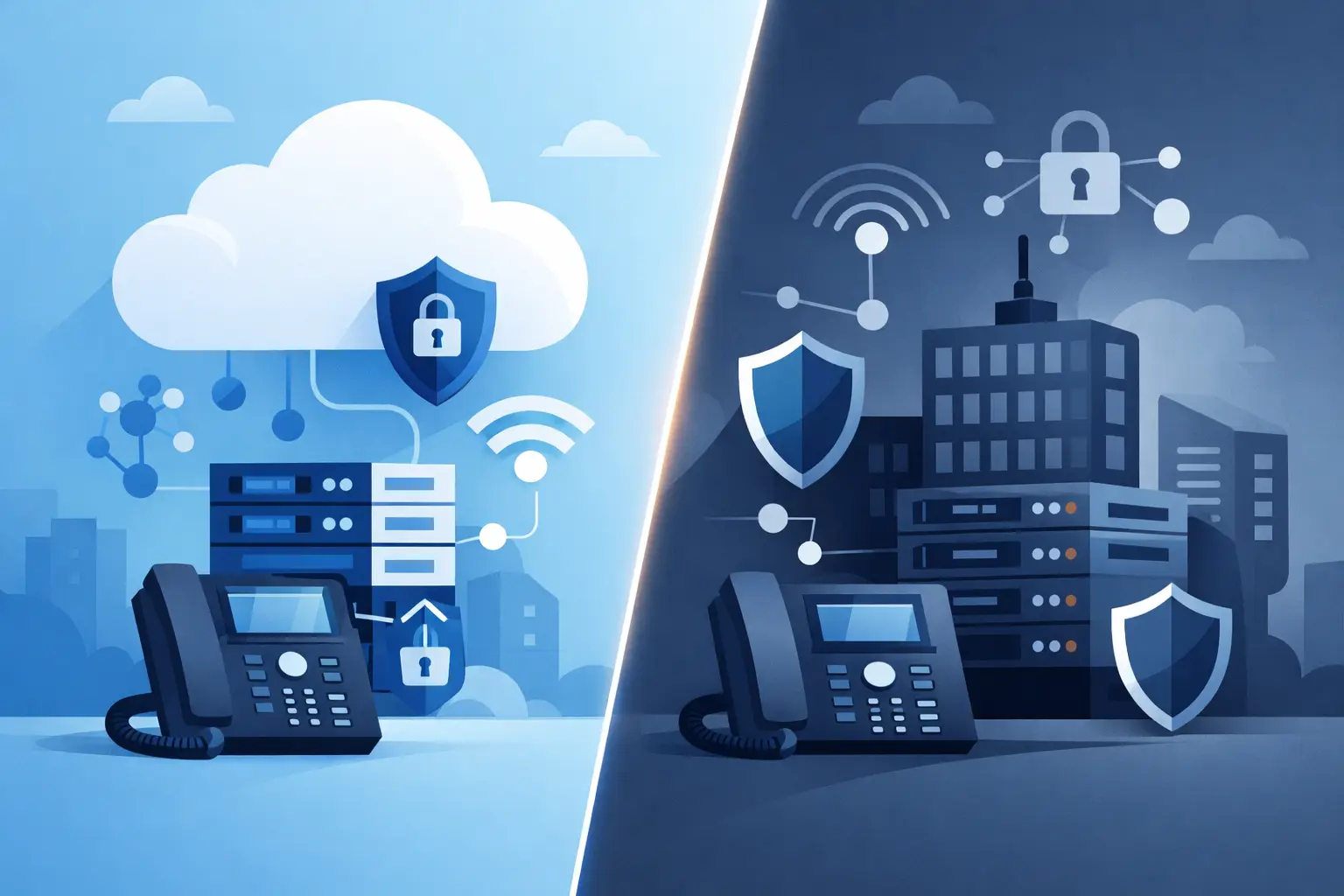
A phone system decision can become an operational risk decision very quickly. When a carrier circuit fails, an office closes unexpectedly, or staff must work from multiple locations, the question is no longer simply which platform has more features. In the cloud PBX vs on premises discussion, IT and operations leaders need to determine which model can protect call continuity, meet security obligations, and remain manageable as requirements change.
For many organizations, the right answer is not based on a universal feature checklist. It depends on the current environment, the age of existing equipment, the network design, regulatory requirements, internal support capacity, and how much control the organization needs to retain.
What separates cloud PBX from on-premises PBX?
An on-premises private branch exchange, or PBX, runs on equipment installed and maintained at an organization’s site. The organization typically owns or leases the hardware, manages software updates, connects carrier services such as SIP trunks or PRI circuits, and assumes responsibility for resilience planning. This approach can support specialized configurations and provides direct control over the core call-control environment.
A cloud PBX moves the call-control platform to a provider-managed data center or cloud environment. Users connect through desk phones, softphones, mobile applications, or existing collaboration tools over an internet connection. The provider operates the underlying platform, handles software maintenance, and can generally add users, locations, and calling features without installing a new PBX appliance at every site.
Neither architecture automatically guarantees reliability or security. A poorly designed cloud deployment can fail during an internet outage. An on-premises PBX without redundant power, carrier diversity, patching discipline, or a disaster recovery plan can create a single point of failure. The practical difference is where responsibility sits and how easily the system can adapt.
Cloud PBX vs on premises: the factors that matter
Cost is more than the monthly bill
On-premises systems often require a larger up-front investment. Hardware, licensing, installation, maintenance agreements, replacement parts, power protection, and technical labor all need to be budgeted. For an organization with a newer PBX, stable staffing, and a team capable of maintaining it, extending its useful life may be financially reasonable.
Cloud PBX services usually shift more of that spending to a predictable operating expense. This can reduce capital requirements and avoid a major refresh cycle, particularly when legacy equipment reaches end of support. However, per-user recurring fees, connectivity upgrades, specialized compliance configurations, and retained analog services should all be included in the total cost analysis.
The most useful comparison looks at three to five years, not just the first contract term. Include the cost of moves, adds, changes, system administration, disaster recovery, carrier circuits, support coverage, and downtime exposure. A low platform price loses its value if the organization must maintain separate vendors for voice, emergency calling, legacy lines, and support.
Reliability depends on the entire voice path
An on-premises PBX can continue providing local calling functions during some WAN disruptions, depending on the carrier connection and configuration. That can be useful for a single facility with a strong local survivability requirement. Yet a site-based system can be vulnerable to local power events, flood, fire, hardware failure, or loss of the building itself unless redundancy is carefully engineered.
A properly designed cloud PBX can distribute risk across geographically separate infrastructure and route calls to alternate numbers, users, or sites when a location is unavailable. For distributed teams, this flexibility is often a major advantage. A receptionist can answer calls from another office, and users can continue working through an approved softphone or mobile application when their primary location is offline.
The trade-off is network dependence. Cloud voice needs adequate bandwidth, quality-of-service policies, reliable local area networking, and a plan for internet outages. Organizations should ask whether a provider offers geographic redundancy, carrier diversity, call-forwarding options, failover procedures, and clear support escalation. They should also determine how emergency calls are handled when users work remotely.
Security and compliance require more than encryption
For commercial organizations, schools, government agencies, and contractors, voice can fall within broader security and compliance obligations. The relevant questions include where call records are stored, who can administer the platform, how access is authenticated, whether data is encrypted in transit and at rest, and how the provider documents controls and incident response procedures.
An on-premises deployment gives an organization direct control over equipment access and segmentation. It also makes that organization responsible for patching servers, securing session border controllers, monitoring logs, managing certificates, and maintaining backup and recovery processes. Control is valuable only when it is supported by the staff and discipline to use it well.
Cloud PBX can reduce the burden of maintaining the core voice platform, but it does not transfer every obligation to the provider. Customers still need role-based access, strong identity controls, secure endpoints, documented user policies, and clear governance for call recording and retention. Government and defense-adjacent organizations should evaluate whether the complete communications architecture, not just one feature, aligns with requirements such as FedRAMP, CMMC, and GCC High operating environments.
Scalability favors organizations with changing requirements
Adding a new office, temporary staff, seasonal employees, or remote workers can be difficult with a capacity-limited PBX. It may require additional cards, licenses, handsets, carrier work, and on-site installation. This is manageable in a stable environment but can slow down organizations that need to move quickly.
Cloud PBX platforms generally make it easier to add and remove users, assign call queues, update auto attendants, and support multiple locations from a central administration point. That does not mean every cloud deployment is simple. Number porting, emergency service records, call-flow design, network readiness, and user adoption still require careful implementation.
For organizations that retain analog devices such as fire alarms, elevator phones, fax machines, security panels, or specialty equipment, migration may also require a POTS replacement strategy. A cloud PBX project should account for these lines early rather than treating them as an afterthought after the primary system has been moved.
When an on-premises PBX may still be the right choice
On-premises PBX remains a valid option when an organization has a recent investment in supported equipment, a highly controlled local environment, specialized integrations, and qualified internal staff. Some facilities also need local survivability because their operational model cannot tolerate dependence on external connectivity, even with failover options.
The key is to assess the actual condition of the system. If the PBX depends on aging PRI circuits, unsupported software, scarce replacement parts, or a single technician with institutional knowledge, retaining it may be less conservative than it appears. Continuing with an existing platform should be a deliberate lifecycle decision, not a default response to migration complexity.
When cloud PBX is the stronger fit
Cloud PBX is often well suited to organizations replacing legacy systems, consolidating multiple offices, supporting hybrid work, or seeking predictable administration and support. It can also simplify a fragmented environment where separate carriers, analog lines, and phone systems have accumulated over time.
For regulated organizations, the strongest fit is usually a cloud design built around the required security model rather than a generic hosted phone package. That may include compliant PSTN connectivity, dedicated voice architecture, defined administrative controls, geographic resilience, and US-based technical support. Intuity approaches these projects as an infrastructure design exercise because the migration plan, network preparation, and continuity strategy matter as much as the platform itself.
A practical way to make the decision
Start by documenting every service connected to the current voice environment: user extensions, toll-free numbers, call queues, emergency lines, analog devices, integrations, carrier contracts, and remote-worker needs. Then identify the cost and consequence of an hour, a day, or a week without normal calling.
Next, evaluate each option against the organization’s own priorities. If local control and specialized integration outweigh agility, an updated on-premises design may be appropriate. If business continuity across locations, simplified management, and easier scale are the priorities, cloud PBX will often provide a better operational model.
The most productive next step is a detailed voice assessment, not a rushed platform purchase. A clear inventory and continuity plan will reveal whether the organization needs to preserve, modernize, or replace its current system before a disruption forces the decision.