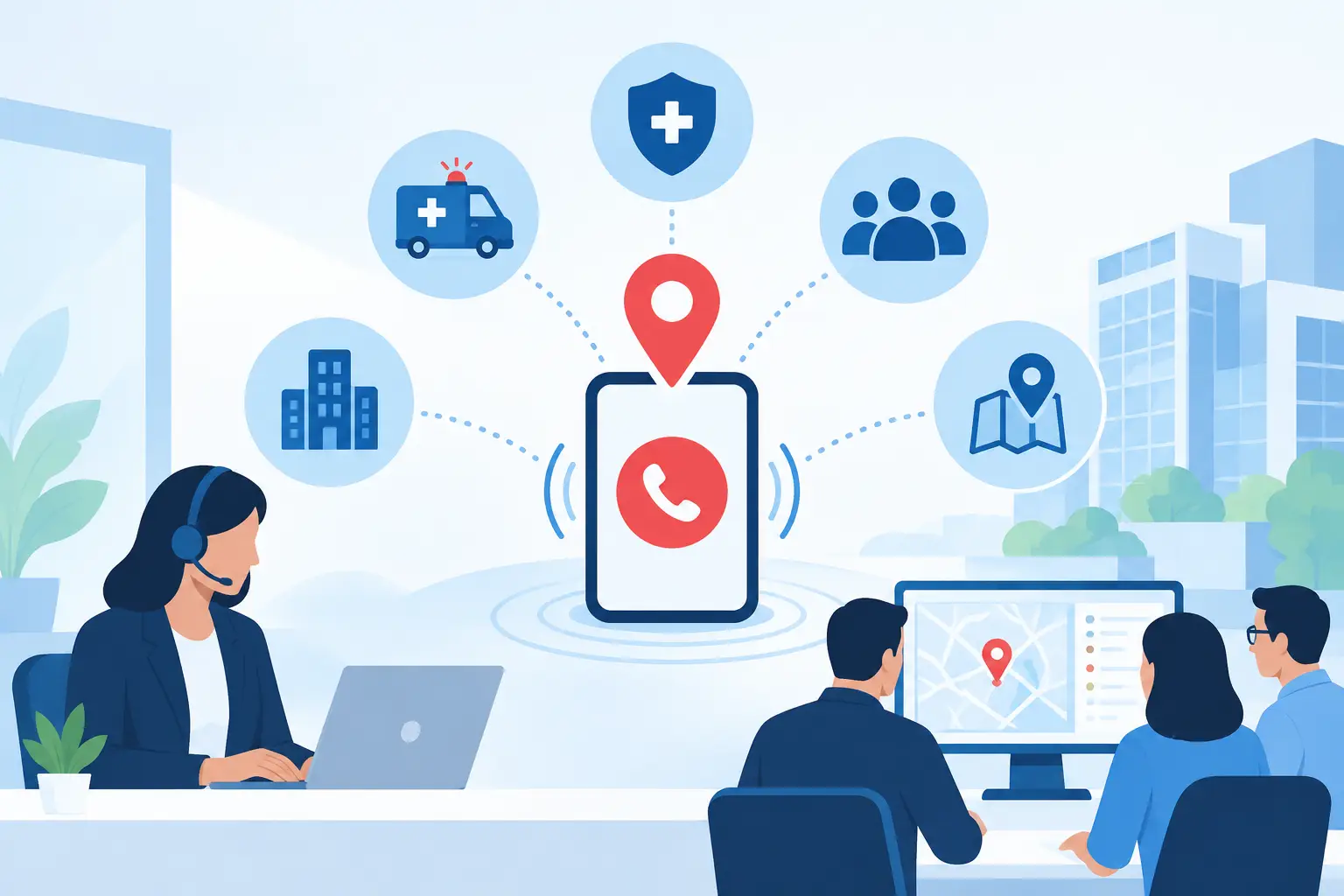
A 911 call from a headquarters reception desk and a 911 call from a hoteling space on the third floor are not the same operational event. Yet many organizations still rely on voice environments that cannot reliably tell emergency responders where a caller is located. E911 platforms address that gap by connecting enterprise calling systems with accurate, actionable location information when an emergency call is placed.
For IT, facilities, security, and compliance leaders, this is not simply a phone-system feature. It is a duty-of-care capability that affects employee safety, regulatory readiness, incident response, and business continuity. The right approach must work across headquarters, branch offices, classrooms, remote sites, and hybrid work arrangements without adding unmanageable administrative overhead.
Why E911 Is Different From Traditional 911
Traditional 911 was designed around fixed telephone lines. A phone number was physically associated with an address, so dispatchers could generally identify the calling location. Enterprise communications changed that assumption. VoIP endpoints can move between offices, users can sign in from different desks, and softphones can operate from virtually anywhere with an internet connection.
Enhanced 911, or E911, is designed to provide more location context to public safety answering points, commonly called PSAPs. In a business setting, that often means supplying a validated street address and, where available, detailed information such as a building, floor, suite, wing, or room. That specificity can matter when responders arrive at a large campus, school district, hospital-adjacent facility, warehouse, or multistory government building.
Federal requirements, including Kari’s Law and RAY BAUM’S Act, have raised the standard for many multi-line telephone systems. Organizations may need to support direct 911 dialing without a prefix, provide on-site notifications for emergency calls, and transmit a dispatchable location. Exact obligations can vary by environment, jurisdiction, and technology deployment, but the operational expectation is clear: a call for help should not depend on someone explaining where they are under pressure.
What E911 Platforms Actually Do
E911 platforms sit between an organization’s calling environment and the emergency services ecosystem. Their function is not limited to sending an address. They help create, maintain, validate, and apply location information as users and devices connect to the network.
A mature deployment typically maps network characteristics to physical locations. Those characteristics may include IP subnet, switch port, Wi-Fi access point, BSSID, or other network identifiers. When a user places a 911 call, the platform uses that information to determine the most appropriate emergency location and route the call accordingly.
The platform can also notify designated internal personnel when an emergency call occurs. Security teams, front-desk staff, facilities managers, and local response teams may receive alerts that include the caller’s number, name, and reported location. This allows the organization to meet first responders, direct them to the right entrance, and provide assistance before help arrives.
The value is especially clear in distributed environments. A school system may need to identify the correct building and classroom area. A public-sector agency may need location accuracy across controlled-access facilities. A commercial organization may need policies that account for employees working in regional offices, temporary workspaces, or home offices.
The Core Capabilities to Evaluate in E911 Platforms
Not all E911 services solve the same problem. Some primarily support static office locations, while others are designed for dynamic environments where devices and users move frequently. The best fit depends on the organization’s voice architecture, facility footprint, workforce model, and risk profile.
Accurate, Maintainable Location Management
Location accuracy starts with data quality. A platform should make it practical to define addresses, buildings, floors, zones, and other location elements in a consistent structure. It should also support validation so emergency addresses are recognized by the appropriate emergency services database.
Ease of administration matters as much as the initial setup. If IT must manually update thousands of users every time a department moves floors, the process will eventually fall behind. Look for workflows that let administrators manage locations centrally, automate assignment where possible, and audit records over time.
Support for Fixed, Nomadic, and Remote Users
A desk phone in a fixed cubicle is relatively straightforward. A laptop softphone, mobile user, or employee working from a temporary office requires more careful planning. Organizations should understand how the platform determines location for each calling method and what happens if location cannot be automatically identified.
For remote staff, a practical policy is often as important as technology. Employees may need to confirm or update their current address before making calls through a softphone. That process should be clear, repeatable, and proportionate to the risk. A company with occasional remote work has different needs than an organization with a permanently distributed workforce.
Emergency Call Notifications
Internal alerting should reach people who can act, not simply a generic mailbox that no one monitors after business hours. Notifications may be sent through email, text message, collaboration tools, or other channels, depending on the platform and organizational policy.
Consider who needs to be notified at each site, what information they require, and how coverage works outside normal hours. A security desk may be appropriate for a large campus. A small branch office may need a regional operations contact and local site manager. Notification plans should reflect real staffing patterns, not an idealized org chart.
Compatibility With Your Voice Environment
E911 capabilities must align with the organization’s calling solution. This includes SIP trunking, cloud PBX services, Microsoft Teams calling, analog endpoints that remain in service, and specialized lines such as elevators, alarms, or emergency phones.
Compatibility should be validated early, particularly during a migration away from PRI, analog POTS lines, or fragmented legacy systems. The emergency-calling design should not be treated as a final configuration task after the voice cutover is complete. It belongs in the architecture and implementation plan from the start.
Common Gaps That Create Risk
The most common E911 failure is assuming that a main office address is enough. A central address may get responders to the property, but it may not identify the correct building, entrance, floor, or room. In a time-sensitive incident, those missing details can create costly delays.
Another issue is treating network changes as separate from location management. When wireless access points are relocated, switch configurations change, or offices are reconfigured, location mappings may become inaccurate. Network, voice, and facilities teams need a shared change-management process.
Organizations also underestimate the impact of hybrid work. A user who takes a laptop home, works from a client site, or connects from a temporary location may not have the same location detection as a user at the corporate office. A documented remote emergency-calling policy helps set expectations and gives employees a clear action to take when their work location changes.
Finally, testing is often too limited. A configuration that appears correct in an administrative portal may not produce the desired result in an actual call flow. Testing should confirm call routing, dispatchable location delivery, internal alerts, and the ability of designated staff to respond appropriately.
Building an E911 Strategy That Holds Up
Start with an inventory of every calling endpoint and location. Include desk phones, softphones, conference rooms, common-area phones, analog devices, security stations, and specialized equipment. Then identify how each endpoint connects, whether it can move, and what location information can be associated with it.
Next, define location granularity based on operational need. A small office may only need a street address and suite number. A multi-building campus may require detailed zone mapping and clear responder instructions. More detail is not automatically better if it cannot be maintained, but the information must be sufficient to direct help effectively.
Bring together the stakeholders who will own different parts of the process: IT manages the calling and network environment, facilities understands the physical layout, security manages on-site response, and legal or compliance teams help interpret organizational obligations. Procurement should also evaluate the provider’s implementation support and ongoing service model, not just the quoted monthly rate.
For regulated organizations, emergency calling should fit within broader communications governance. That means documenting configuration standards, retaining relevant records, establishing review intervals, and ensuring the service provider can support the security and compliance requirements surrounding the broader voice environment. For government agencies and contractors, this may include assessing how the E911 design fits with GCC High or other controlled communications architectures.
E911 Platforms Are an Operational Decision
An E911 platform is most effective when it is treated as part of the organization’s safety and communications strategy rather than a compliance checkbox. The technology must be accurate, but the surrounding processes must also work: location records need ownership, network changes need review, employees need clear guidance, and emergency notifications need people prepared to act.
For organizations modernizing business voice services, this is an opportunity to replace fragmented emergency-calling practices with a design that supports the way people actually work. Intuity helps organizations evaluate voice infrastructure, location requirements, and operational continuity together, so emergency calling is considered before a migration creates new gaps.
The right question is not whether your phone system can dial 911. It is whether, when a person needs help, your organization can provide responders with the location and context they need without hesitation.