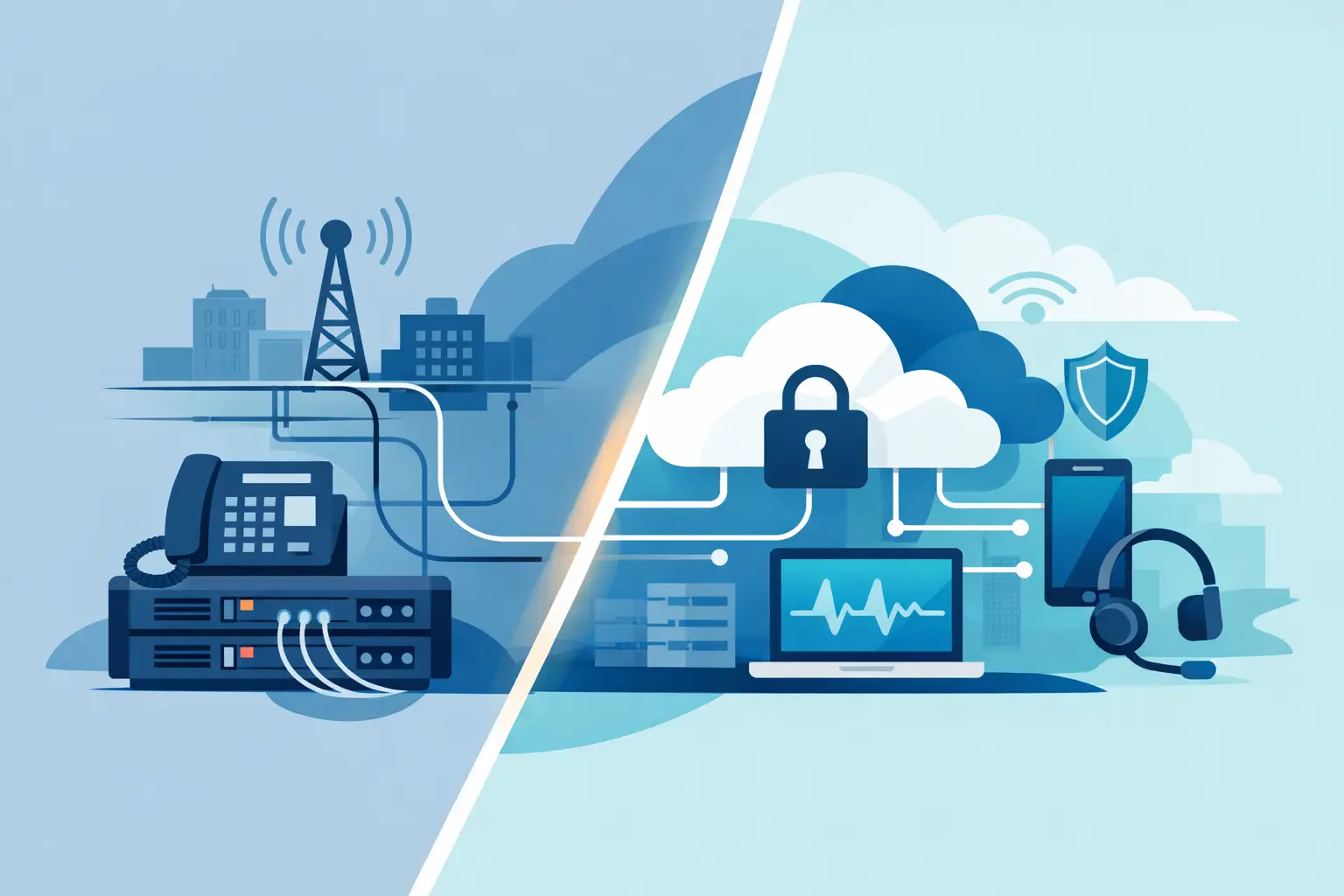
If your phone system still depends on PRI circuits, you are likely paying for rigidity as much as dial tone. PRI served enterprises well for years, but it was built for a communications model that assumed fixed offices, predictable call volumes, and on-premises hardware. For organizations asking how to modernize PRI lines, the real question is not whether to change. It is how to do it without disrupting operations, introducing compliance gaps, or creating a new management burden.
For IT leaders, school administrators, procurement teams, and public-sector technology managers, PRI modernization is usually tied to something bigger. A carrier is retiring legacy services. A PBX is aging out. Remote and hybrid staff need direct calling access. Or the organization needs more resilience than a single physical circuit can provide. Modernization works best when it is treated as an infrastructure decision, not just a telecom refresh.
What modernizing PRI lines really means
In most cases, how to modernize PRI lines comes down to moving from fixed, hardware-dependent voice connectivity to SIP trunking or a broader cloud communications model. Instead of relying on dedicated copper or T1-based circuits, SIP uses IP connectivity to carry voice traffic with more flexibility in call routing, scaling, and redundancy.
That does not always mean replacing everything at once. Some organizations keep their existing PBX and transition the carrier side first. Others use PRI modernization as the moment to move to hosted voice, Microsoft-integrated calling, or a hybrid architecture that supports both legacy locations and newer cloud-based workflows.
The right model depends on your current environment. A centralized call center, a school district with multiple sites, and a government contractor working inside GCC High will not have the same requirements. The goal is not to force every organization into the same design. The goal is to remove the limits of PRI while preserving reliability and control.
Why PRI is becoming a business liability
PRI is familiar, but familiarity is not the same as suitability. Legacy circuits often create cost and operational issues that are easy to accept simply because they have existed for so long.
Capacity is one of the clearest examples. PRI gives you a fixed number of channels. If you need more, you add more circuits, even if demand only spikes occasionally. If call volume drops, you still pay for that dedicated capacity. SIP trunking is typically more flexible, which makes it easier to align spending with actual usage.
Resiliency is another concern. A physical PRI circuit can become a single point of failure. When a site loses connectivity or equipment fails, recovery options are often limited. A modern voice architecture can route calls across redundant paths, fail over to alternate locations, and support users outside the office more effectively.
There is also the issue of supportability. As carriers continue phasing out legacy infrastructure, organizations may face longer repair times, fewer service options, and shrinking vendor expertise around older telephony environments. That does not mean PRI stops working overnight. It does mean the risk profile changes over time.
How to modernize PRI lines in a controlled way
The safest path starts with assessment, not replacement. Before selecting a provider or architecture, document how voice is actually used across the organization. That includes main numbers, fax dependencies, alarm lines, elevator phones, call paths, contact center workflows, hunt groups, DID inventory, failover needs, and any compliance obligations attached to voice traffic.
This phase matters because PRI environments often support more than expected. A location may appear to have a simple trunk setup while also carrying critical inbound routing for a public-facing department, seasonal overflow traffic, or legacy devices no one has inventoried recently. Missing those dependencies is what turns a migration into a problem.
Start with the PBX and network reality
Not every PRI modernization requires a full phone system replacement. If your PBX is SIP-capable or can support SIP through a gateway, you may be able to preserve existing investments while replacing the circuit layer. That can reduce disruption and spread costs over time.
However, if the PBX is near end of life, unsupported, or unable to meet current security expectations, keeping it may only delay a larger problem. In those cases, moving to a hosted or cloud-managed platform may be the more cost-effective decision over the next several years.
Network readiness also deserves close attention. Voice quality over IP depends on bandwidth, latency, jitter, packet loss, and traffic prioritization. A PRI line can mask local network weaknesses because the circuit itself is dedicated. SIP exposes whether the underlying network is properly designed for real-time communications.
Match the migration model to the organization
There are three common approaches. The first is a direct PRI-to-SIP replacement that leaves the phone system in place. This is often a practical option for organizations that need quick cost savings and better carrier flexibility without changing user experience right away.
The second is a phased hybrid migration. Some sites or departments move first, while others remain on legacy systems until contracts, budgets, or technical requirements line up. This works well for distributed organizations, especially those with multiple campuses or a mix of modern and older infrastructure.
The third is a full cloud voice transition. This approach makes sense when PRI retirement is part of a broader effort to simplify telephony, support remote staff, centralize management, and improve business continuity. It can deliver the biggest operational benefits, but it also requires stronger planning around user adoption, call flows, and integration.
Security and compliance cannot be afterthoughts
For regulated organizations, the question of how to modernize PRI lines is tied directly to risk management. Voice traffic may involve protected information, sensitive operational details, or contractual compliance obligations. That changes provider selection and architecture decisions.
A low-cost SIP option may look attractive on paper, but if it lacks proper redundancy, security controls, support responsiveness, or alignment with frameworks like FedRAMP, GCC High, or CMMC-related environments, it may create more exposure than value. The same is true if the migration introduces unmanaged endpoints, weak authentication, or poorly documented routing.
This is where a consultative provider matters. Modernization should include call encryption where applicable, secure configuration standards, geographic redundancy, clear service accountability, and support teams that understand the compliance context of the environment. For public-sector and government-adjacent organizations, that expertise is not optional.
Cost savings are real, but they are not the only ROI
Many organizations begin PRI modernization to lower monthly telecom costs, and that is often achievable. SIP can reduce carrier spend, eliminate unused circuit capacity, and simplify moves, adds, and changes.
Still, the stronger business case is usually operational. Modern systems improve survivability during outages, make it easier to add users or sites, support remote work without workarounds, and reduce dependence on specialized legacy hardware. They also give IT teams more visibility into call routing and performance.
There are trade-offs. A modernized environment may shift spending from fixed circuits to broader network and service management. Some organizations will need session border controllers, upgraded licensing, or LAN improvements. Savings should be modeled over time, not judged only by the first invoice comparison.
Common mistakes to avoid
The most common mistake is treating PRI modernization as a carrier swap and nothing more. That approach can overlook call flow redesign, redundancy planning, emergency calling requirements, and device compatibility.
Another mistake is underestimating cutover complexity. Number porting, test windows, failback planning, and user communication all matter. A good migration should feel uneventful to end users because the hard work happened before the cutover date.
It is also a mistake to assume every line should move the same way. Some analog or specialty services may need separate planning. Some locations may justify a hybrid setup for a period of time. Modernization is not about forcing uniformity. It is about creating a more supportable and resilient communications environment.
What a good PRI modernization partner should provide
A capable provider should do more than quote trunk replacement. They should assess your current environment, identify dependencies, validate network readiness, map a phased migration strategy, and design for uptime. They should also be prepared to support compliance-sensitive use cases and provide responsive post-cutover support.
For organizations in education, commercial enterprise, and government-related sectors, that combination of technical depth and operational discipline makes the difference between a successful migration and a disruptive one. Intuity’s approach, for example, is built around secure voice infrastructure, tailored implementation, and resilient communications design for organizations that cannot afford avoidable downtime.
PRI lines had a long run because they solved the right problem for their era. Modern communications require something more flexible, more resilient, and better aligned with how organizations operate now. The smartest next step is not to wait for the legacy environment to force your hand, but to modernize on a timeline you can control.