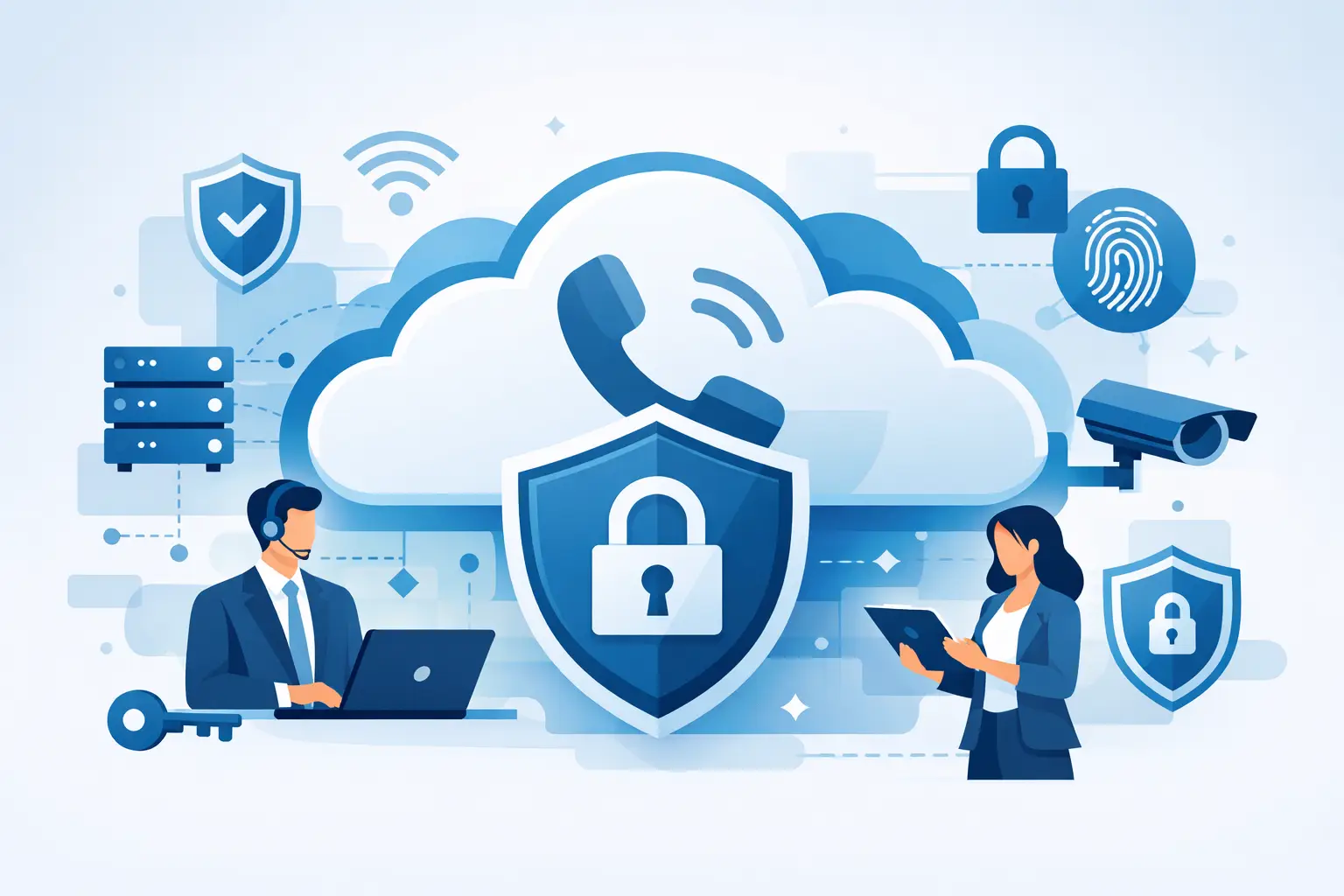
A cloud phone system can reduce cost and simplify operations, but it also changes your risk profile. If you are evaluating how to secure cloud telephony, the real question is not whether the platform is hosted on-premises or offsite. It is whether every layer around voice access, routing, administration, and compliance has been designed to withstand both routine failures and targeted abuse.
For IT leaders, school administrators, procurement teams, and public-sector technology managers, that distinction matters. Voice is still a mission-critical service. Calls to customers, parents, vendors, field staff, and emergency contacts cannot fail because of weak authentication, poor carrier controls, or a provider that treats security as an add-on.
How to secure cloud telephony starts with architecture
Security problems in cloud telephony often begin before the first phone is provisioned. Organizations focus on features, seat pricing, and migration speed, then discover later that call paths, admin roles, and connectivity methods were never aligned to internal security requirements.
A more reliable approach is to evaluate the architecture first. That includes how calls enter and leave the environment, where session control occurs, how voice traffic is segmented from other business traffic, and which systems can administer users, numbers, and routing policies. If your organization has multiple sites, remote users, contact centers, or regulated departments, those boundaries should be defined early.
This is also where trade-offs emerge. A highly centralized design can simplify oversight, but it may create a larger blast radius if administrative access is compromised. A more segmented model can improve control, but it introduces added management complexity. The right choice depends on your size, compliance obligations, staffing, and tolerance for operational risk.
Identity and access control are the first line of defense
Most telephony breaches do not begin with sophisticated voice attacks. They begin with compromised credentials, weak admin hygiene, or too many people having too much access.
Administrative portals for cloud PBX, SIP services, and carrier management should be protected with strong password policies and multi-factor authentication. That should apply not only to internal IT staff, but also to resellers, implementation partners, and support contacts who may have elevated permissions. Shared administrator accounts create audit gaps and should be avoided.
Role-based access matters just as much. A help desk user who only needs to reset voicemail pins should not be able to reroute main numbers or alter emergency calling settings. Finance teams reviewing invoices should not have the ability to provision trunks. Limiting privileges reduces the chance that one compromised account can disrupt the entire phone environment.
Single sign-on can improve control when it is integrated properly with your identity provider, but it is not automatically safer in every case. If your identity stack is mature and monitored, centralizing access may reduce risk. If identity governance is inconsistent, tying telephony administration to that same system can carry existing problems into another critical service.
Protect signaling, media, and network paths
When organizations ask how to secure cloud telephony, they often focus on user authentication and overlook the network layer. Voice signaling and media streams should be protected in transit, especially for organizations with remote users, distributed offices, or sensitive conversations.
Encryption for signaling and media is a key control, but it should be validated, not assumed. Ask where encryption terminates, whether all endpoints support it consistently, and what happens when calls traverse external carriers or legacy interconnections. There are environments where encrypted transport is straightforward, and others where compatibility requirements require careful planning.
Network segmentation also deserves attention. Voice traffic should not compete freely with every other business application on a flat network. Separating voice services can improve both performance and containment. If a malware event spreads across the data network, segmentation can make it harder for that incident to affect telephony administration or call quality.
That said, segmentation is not a substitute for monitoring. Poorly configured firewalls, insecure session border policies, and permissive access control rules can still expose services. Security teams and telephony teams need shared visibility into traffic patterns, failed registrations, unusual routing attempts, and abnormal calling behavior.
Fraud prevention needs carrier-level controls
Toll fraud remains one of the most expensive and preventable telephony risks. Attackers target voicemail systems, exposed SIP credentials, weak international dialing policies, and poorly monitored call flows. The damage is not limited to charges. Fraud events can also interrupt legitimate service and trigger compliance concerns.
The basic controls are straightforward but often inconsistently applied. International and premium-rate dialing should be restricted unless there is a clear business requirement. Call spending thresholds, destination controls, time-of-day policies, and real-time alerts should be configured at the platform or carrier level. If those controls only exist in policy documents and not in the service design, they will not help when an attack starts after hours.
Review voicemail security as well. Default PINs, overly simple passcodes, and publicly exposed mailbox prompts still create openings. In some environments, disabling external voicemail access for certain user groups is the better choice.
This is one reason provider selection matters. A cloud telephony vendor should not only offer service availability. It should also support active fraud detection, responsive escalation, and clear administrative controls that allow your team to limit exposure without waiting for a ticket queue.
Compliance is part of security, not a separate workstream
For commercial organizations in regulated sectors, educational institutions, and government-related environments, telephony security cannot be separated from compliance requirements. The controls that protect voice infrastructure should support your broader obligations around data handling, logging, retention, access review, and continuity.
That is particularly relevant for agencies and contractors operating under frameworks such as FedRAMP, CMMC, or GCC High-related requirements. In those cases, secure voice services are not only about encrypted calling. They are about whether the service environment, support model, and connected systems align with the standards your organization is expected to meet.
It depends, however, on the role telephony plays in your environment. A basic business phone deployment may not need the same documentation depth or boundary controls as a voice service supporting regulated workflows, emergency operations, or contractor communications tied to controlled information. The mistake is assuming that one commercial cloud offering fits every risk category.
A consultative provider can help map service design to your actual compliance posture. That usually includes reviewing where administration occurs, how records are handled, what redundancy is in place, and whether the service can support your reporting and audit expectations.
Business continuity is a security requirement
A secure phone system is not simply one that blocks unauthorized access. It is one that continues operating when circuits fail, sites go down, staff work remotely, or a carrier path is disrupted.
Redundancy should be evaluated across trunks, geographic routing, failover policies, and endpoint options. If your headquarters loses connectivity, can calls be rerouted automatically to another site, to mobile devices, or to a continuity queue? If a platform issue occurs, are there alternate call paths available? Those are security questions because service outages create operational and reputational risk.
Emergency calling should be part of this review. Dynamic work locations, softphones, shared devices, and hybrid staffing can complicate emergency response if location management is outdated. Schools, healthcare organizations, and public-sector entities in particular need confidence that emergency dialing behavior matches real-world usage.
Testing matters here. A continuity plan that has never been exercised is only a theory. Run failover tests, admin access checks, and emergency call validation on a scheduled basis, especially after moves, adds, changes, or network updates.
Vendor due diligence should be operational, not just contractual
Security questionnaires have value, but they rarely tell the full story. If you want to know how to secure cloud telephony over the long term, evaluate how a provider operates day to day.
Ask how incidents are detected and escalated. Ask who supports the service, how quickly routing changes can be made, and what visibility your team will have into call activity and administrative events. Review service boundaries carefully, especially if multiple vendors share responsibility for connectivity, platform management, and endpoint support.
This is where a single-source provider can simplify risk management. Fewer handoffs generally mean fewer gaps in accountability. For organizations with compliance-sensitive communications, that can make a meaningful difference in response time and control consistency. Intuity works with clients that need exactly that kind of alignment across secure voice architecture, compliance requirements, and operational continuity.
The strongest telephony environments are usually not the ones with the longest feature lists. They are the ones designed with clear access controls, carrier safeguards, validated continuity planning, and a provider that understands the cost of failure. If your phone system supports critical operations, security should be built into every call path before you trust it with the next one.