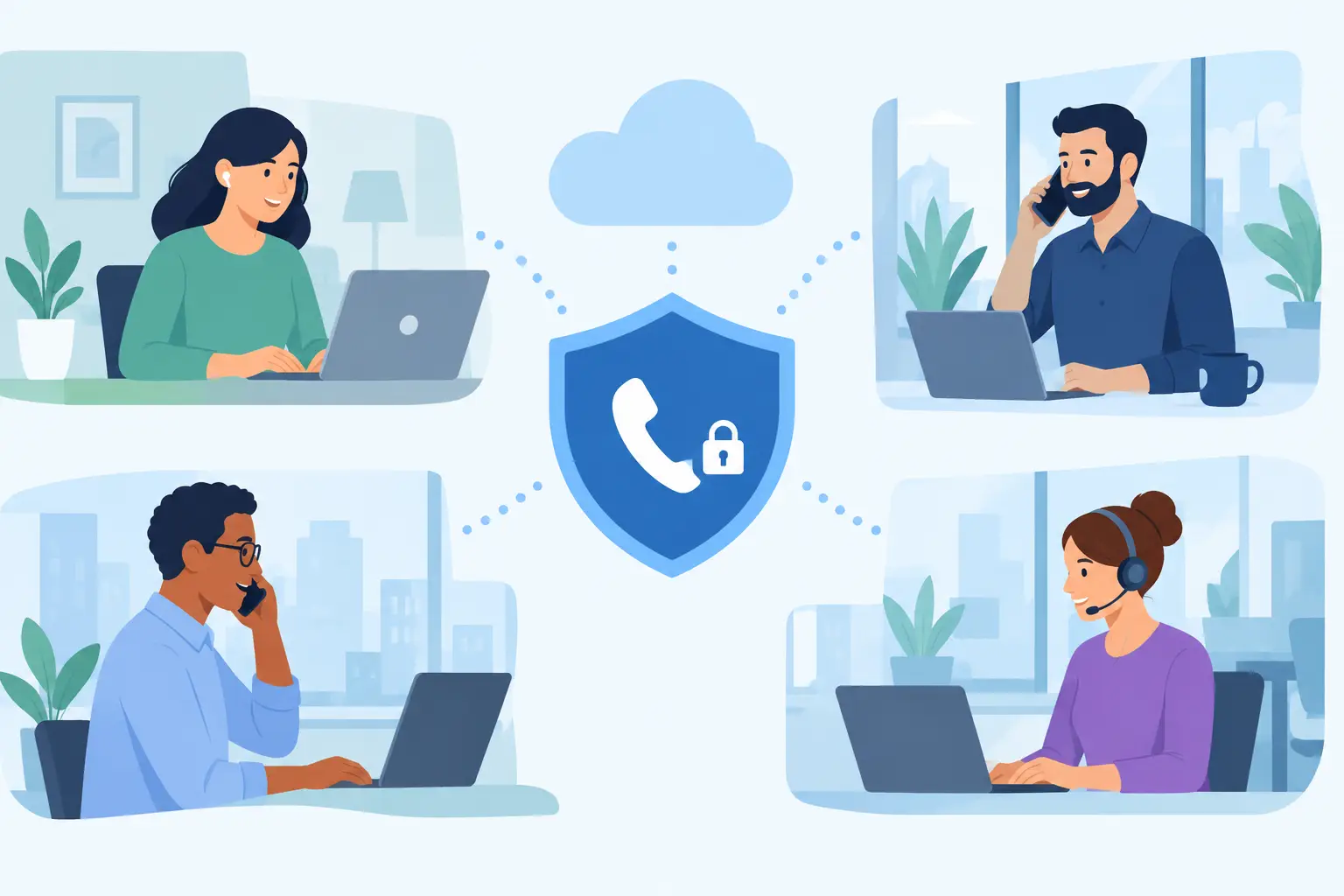
A hybrid employee’s work location can change three times in one day: a home office in the morning, a customer site in the afternoon, and a headquarters desk for an urgent meeting. Their business phone number, caller identity, call quality, and access to emergency services must remain dependable through each move. That is the operational standard behind how to support hybrid workforce calling effectively.
For IT and operations leaders, the issue is not simply giving employees a softphone app. It is building a calling environment that preserves control when users, networks, and devices are outside the traditional office perimeter. The right approach balances employee flexibility with security, compliance, resiliency, and a consistent customer experience.
Start With the Calling Experience You Need to Protect
Before selecting platforms or moving numbers, define the calls that matter most to the organization. A sales team may need reliable outbound caller ID and CRM-friendly routing. A school district may need every campus, department, and emergency location represented accurately. A government contractor may require calling that fits within a tightly controlled Microsoft GCC High environment.
This review should distinguish between routine collaboration calls and business-critical public telephone service. Internal meetings can often tolerate a brief interruption or a lower-quality connection. Customer service lines, dispatch phones, executive lines, security desks, and emergency calls cannot. Treating every call type the same can either create unnecessary cost or leave critical functions exposed.
Document how calls enter the organization, where they route, who answers after hours, and what should happen during an internet, power, or platform outage. This exercise often reveals dependencies that were invisible when everyone used desk phones in one building.
How to Support Hybrid Workforce Calling With Cloud Voice
Cloud voice infrastructure gives organizations a practical way to separate phone service from a physical office. Instead of tying a phone number to a specific copper line, PRI circuit, or handset, the organization can deliver calling to approved desk phones, computer clients, mobile applications, or contact center tools.
That flexibility should not mean unmanaged calling. A well-designed cloud deployment keeps the company number, dial plan, voicemail, call recording requirements, and routing rules under centralized administration. Employees can work from different locations without presenting a personal mobile number to customers or creating disconnected communications silos.
SIP trunking is often a core part of this model. It can connect existing PBX investments or newer unified communications platforms to the public telephone network while supporting growth without the lead times and fixed capacity associated with many legacy voice circuits. The right design depends on whether an organization is retaining an on-premises phone system, moving fully to a cloud platform, or operating a mixed environment during migration.
For regulated organizations, the public telephone network connection also deserves scrutiny. Calling services should align with the organization’s security architecture, identity controls, data-handling requirements, and platform environment. For example, GCC High users may need PSTN connectivity designed specifically for that environment rather than an improvised connection that creates administrative or compliance concerns.
Design for the Network Conditions Employees Actually Have
Hybrid calling is only as reliable as the path between the user and the voice platform. Office networks are usually managed. Home networks often are not. An employee may share bandwidth with streaming devices, gaming consoles, smart home equipment, and other household users just as an important customer call begins.
A reasonable home internet connection can support voice well, but bandwidth alone is not the full story. Latency, jitter, packet loss, Wi-Fi coverage, VPN configuration, and local device performance all affect call quality. IT teams should establish baseline requirements for supported home connectivity and provide clear guidance on wired connections, router placement, and when to use a company-managed mobile option.
At the office, voice traffic should receive appropriate priority on the local network. Quality of service policies, network segmentation, current switching equipment, and sufficient internet capacity help prevent large uploads, guest Wi-Fi traffic, or software updates from degrading active calls. These measures are particularly valuable where a smaller location must support both on-site staff and remote workers using the same cloud services.
Do not assume a VPN is always the best path for voice. Some architectures perform well with voice traffic routed through a secure internet connection and protected through modern identity, device, and session controls. Others require VPN routing because of application or policy requirements. Test both the security model and the call-quality impact before making a broad policy decision.
Secure Identities, Devices, and Call Routing
A hybrid calling program expands the number of endpoints accessing business voice. That makes identity management a primary control, not an administrative detail. Multi-factor authentication, single sign-on where appropriate, strong password policies, and prompt deprovisioning reduce the chance that former employees or compromised accounts can place calls using company services.
Device policy should be equally clear. Decide which personal devices can access calling applications, whether mobile device management is required, and how data is protected on laptops and phones. A bring-your-own-device program can reduce hardware spending, but it may create additional privacy, support, and security obligations. In more sensitive environments, managed devices are usually the more defensible choice.
Fraud prevention also requires attention. Toll fraud, unauthorized international calling, and suspicious call forwarding can create substantial exposure. Set permissions based on role, restrict unnecessary international dialing, review unusual calling patterns, and use a provider that can assist with monitoring and response. These controls are not merely financial safeguards. They also help preserve the integrity of the organization’s caller identity.
Treat Emergency Calling as a Location Management Problem
Hybrid work changes emergency calling responsibilities because the user may not be at the address associated with the company’s main office. If an employee places an emergency call from home, a hotel, or a temporary worksite, responders need usable location information.
Establish a process for collecting and maintaining user locations where required by the calling platform and applicable regulations. Employees should understand when they need to update their emergency address, especially after a move or extended temporary assignment. For offices, validate dispatchable locations down to the level needed for responders to find the caller quickly.
This work should include periodic testing and ownership. Human resources may know where employees are assigned, facilities may control office location data, and IT may administer the calling system. Unless one team is accountable for keeping records current, emergency location accuracy can deteriorate quietly over time.
Build Resiliency Beyond a Single Internet Connection
The promise of hybrid work is continuity, but that promise fails if every calling path depends on one local circuit, one power source, or one routing rule. Critical locations should have documented failover plans that address carrier outages, local internet loss, power interruptions, and platform-level incidents.
For some offices, a secondary internet connection and backup power are appropriate. For others, automatic call forwarding to alternate sites, mobile devices, or an answering group provides a more cost-effective safeguard. The correct level of redundancy depends on the business impact of an outage. A branch office with a small administrative staff has different requirements than a public safety-related operations center or a 24-hour customer support line.
Resiliency also includes capacity planning. Review concurrent call needs during normal operations and during failover events. An organization may have enough calling capacity for daily operations but not enough for an entire office to reroute through another location after an outage.
Standardize Support Without Making Employees Guess
A hybrid calling deployment needs a support model that works outside business headquarters. Employees should know how to report a one-way audio issue, a failed login, poor call quality, or an emergency address change. They should not need to determine whether the cause is their internet provider, a headset, a computer setting, the collaboration platform, or the voice carrier.
Create a simple escalation path with defined responsibilities between internal IT, managed service partners, and the voice provider. Include the information support staff need to troubleshoot quickly, such as the user’s location, device, network connection type, time of the call, calling and called numbers, and the nature of the failure.
Training matters as well. A short, role-specific onboarding session can prevent common issues involving headset selection, call transfers, voicemail, mobile usage, and status settings. The goal is not to turn every employee into a telecom administrator. It is to give them enough confidence to use business calling consistently and report problems clearly.
Measure Service Quality and Adjust the Design
Once hybrid calling is live, measure more than ticket volume. Review call quality trends, failed call attempts, outage frequency, response times, adoption by user group, and costs associated with unused lines or overlapping services. These metrics show whether the design is meeting operational needs or simply shifting old problems to a new platform.
Pay particular attention to exceptions. A single executive home office with poor connectivity, a remote warehouse with limited broadband options, or a department using specialized analog equipment may need a tailored solution. POTS replacement, cellular backup, dedicated connectivity, or a retained local service can be appropriate when standard cloud calling does not fit the use case.
Intuity helps organizations assess these dependencies and design secure voice services around the platforms, locations, and compliance requirements they already manage. The most effective hybrid calling strategy is not the one with the longest feature list. It is the one that gives every employee a dependable way to connect while keeping the organization in control when conditions change.