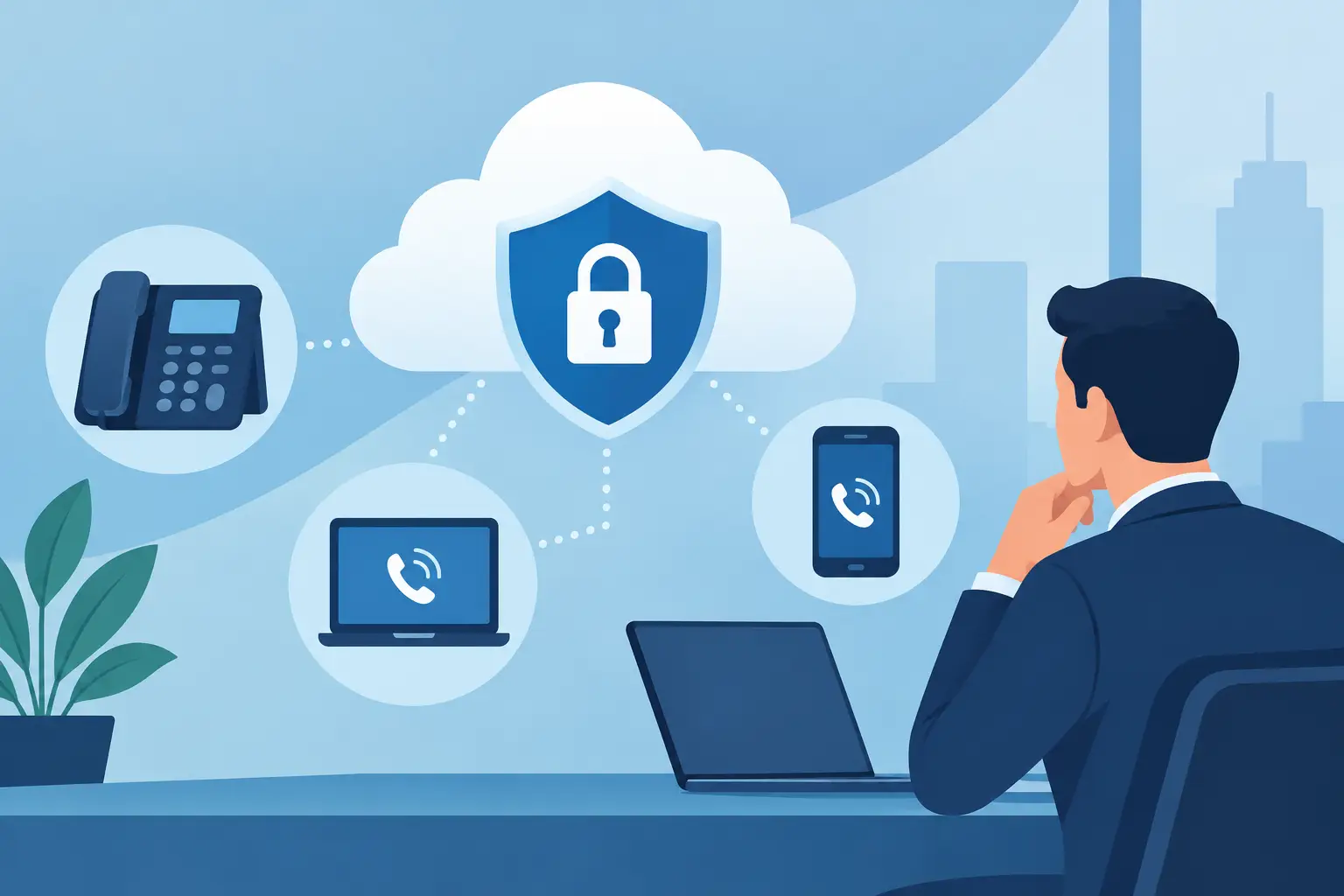
A cloud phone system can remove aging PBX hardware, simplify remote calling, and reduce the number of carriers an IT team must manage. But for organizations handling sensitive conversations, the practical question is more direct: is hosted voice secure enough for our users, data, and compliance obligations?
The answer is yes, provided the hosted voice service is designed, deployed, and operated with the right controls. Hosted voice is not automatically secure merely because it is cloud-based. Security depends on how voice traffic is encrypted, how users and administrators are authenticated, how the provider protects its network, and how well the solution fits the organization’s regulatory requirements.
For IT leaders, the goal is not simply to replace phone lines. It is to establish a communications environment that is easier to manage, more resilient during disruption, and defensible under security review.
Is Hosted Voice Secure by Design?
Hosted voice moves call control, routing, and often phone-system management from an on-premises appliance to provider-operated infrastructure. That shift can improve security because a qualified provider can maintain specialized voice security controls, monitor threats continuously, and build redundancy that would be expensive to replicate at every customer site.
Still, responsibility is shared. The provider is responsible for protecting its service infrastructure and maintaining the security features it has committed to deliver. The customer remains responsible for user access, administrator permissions, endpoint configuration, local network security, and internal calling policies.
A secure hosted voice design generally protects three areas: signaling, media, and management access. Signaling tells the system how to establish, route, transfer, or end a call. Media is the voice stream itself. Management access includes the administrative portals and APIs used to configure users, numbers, call flows, and reporting.
If any one of these areas is neglected, a technically capable voice platform can still create risk. An encrypted call path does little to prevent fraud if an attacker has obtained an administrator’s credentials. Strong identity controls cannot compensate for unprotected phones on an exposed network.
The Controls That Protect Business Calls
Encryption for signaling and voice media
Transport Layer Security, or TLS, can protect SIP signaling as it moves between endpoints, session border controllers, and the hosted platform. Secure Real-time Transport Protocol, or SRTP, can encrypt the audio stream. Together, these technologies help prevent unauthorized parties from reading call setup details or listening to voice traffic in transit.
Encryption must be supported end to end where possible. Calls may traverse desk phones, softphone applications, local networks, public internet connections, carrier interconnects, and PSTN gateways. Each transition should be understood. A call that leaves the encrypted VoIP environment for the public telephone network may be subject to different protections on that portion of its route.
For many organizations, this is not a reason to avoid hosted voice. It is a reason to ask precise questions about call paths, encryption standards, certificate management, and where traffic is decrypted or handed off.
Identity and administrative access controls
Voice systems hold more than extension numbers. They may expose voicemail, call recordings, call detail records, directory information, forwarding rules, emergency location data, and configuration privileges. That makes identity security central to hosted voice.
Multi-factor authentication should protect administrative accounts and, where the platform supports it, end-user portals and softphone access. Role-based access control limits each administrator to the functions required for their job. A help desk employee who resets voicemail PINs should not automatically have authority to reroute a main number or change international dialing permissions.
Security also improves when organizations remove dormant accounts promptly, review elevated permissions regularly, and use separate administrative identities rather than everyday user accounts for sensitive changes. These controls are ordinary IT hygiene, but they are especially valuable in voice environments where a single configuration change can affect customers, emergency calling, or business continuity.
Session border controls and fraud prevention
Session border controllers, or SBCs, act as controlled gateways between voice networks. They can validate signaling, enforce call policies, conceal internal network details, manage interoperability, and help block malformed or suspicious traffic.
SBCs also play a significant role in preventing toll fraud. Criminals often target poorly secured SIP credentials, open dialing rules, or compromised accounts to place expensive calls before the activity is detected. A secure service should support practical controls such as international calling restrictions, destination controls, spending thresholds, concurrent-call limits, anomaly detection, and alerting.
The right policies depend on how the organization operates. A global support center may require international calling that a regional school district does not. Security should not become an obstacle to legitimate operations, but permissive calling rules should be intentional, documented, and monitored.
Network segmentation and endpoint security
Hosted voice security does not stop at the provider edge. IP phones, conference devices, analog adapters, and softphone-enabled laptops all connect from the customer environment. Placing voice devices on a segmented network or dedicated voice VLAN can reduce exposure to lateral movement and limit the effect of a compromised device.
Organizations should also keep phone firmware current, change default credentials, disable unused services, and maintain an inventory of endpoints. For remote staff, managed devices, endpoint protection, secure home-router practices, and approved softphone applications matter just as much as they do for other cloud services.
Quality of service is often discussed alongside VoIP, but it solves a different problem. QoS can prioritize voice packets to improve call quality. It is not a substitute for encryption, access control, or network segmentation. Reliable communications require both performance engineering and security engineering.
Security, Reliability, and Compliance Are Connected
For commercial organizations, schools, and public-sector entities, a secure voice system must also remain available. A service that encrypts calls but fails during a carrier outage, regional disruption, or denial-of-service event does not meet the operational requirement.
This is why redundancy matters. Evaluate how the provider handles geographically diverse infrastructure, carrier diversity, failover routing, disaster recovery, DDoS mitigation, and number-porting contingencies. Ask how inbound calls can be rerouted if a site loses connectivity, and whether users can continue calling through approved applications or alternate locations.
Compliance adds another layer. Healthcare, financial services, education, government, and government contractors may need documented safeguards, auditability, retention policies, access controls, or approved cloud environments. No voice provider can make an organization compliant by itself. However, a provider should be able to explain which controls it operates, what documentation it can provide, and where the customer’s responsibilities begin.
For agencies and contractors working in Microsoft GCC High environments, PSTN connectivity needs particular attention. The voice architecture should preserve the boundary and operational requirements of the broader environment rather than introducing unmanaged call paths or separate tools that complicate oversight. Intuity works with organizations that need this type of compliance-aware voice design, including secure PSTN connectivity aligned to demanding operational requirements.
How to Evaluate a Hosted Voice Provider
A sales conversation should not end with a statement that the platform is “secure.” Request specifics that your IT, security, and compliance teams can evaluate. The following questions reveal whether a provider can support a serious security review:
- Which protocols protect SIP signaling and voice media, and when is encryption applied?
- How are administrative accounts secured, including multi-factor authentication and role-based access?
- What protections identify and limit toll fraud, denial-of-service activity, and unauthorized call attempts?
- How is service continuity maintained during network, carrier, or data center disruptions?
- What compliance documentation, audit evidence, and incident-response processes are available?
Also ask about support ownership. During a voice outage or suspected compromise, teams need to know who answers, what information is available, and how quickly configuration changes can be made. A provider with US-based support and clear escalation procedures can materially reduce the time between identifying an issue and restoring service.
Common Gaps After Deployment
Even well-planned migrations can develop weaknesses over time. The most common are not usually failures of encryption. They are operational gaps: former employees with active accounts, broad administrator permissions, unreviewed call forwarding, unrestricted international dialing, unmanaged softphone use, and outdated emergency location records.
Treat hosted voice as part of the broader security program. Include it in access reviews, incident-response planning, vendor assessments, change management, and business continuity exercises. Review call-routing rules after organizational changes and test failover before an actual disruption forces the issue.
A hosted voice platform should make this ongoing work more manageable, not more fragmented. Centralized visibility, policy controls, and knowledgeable support are valuable because they give IT teams a clearer operating model than a collection of legacy phone lines and disconnected carriers.
The best next step is to assess voice security against the way your organization actually communicates. Map the call paths, identify who can change them, test what happens when connectivity fails, and choose a provider prepared to support both the technical design and the accountability that follows.