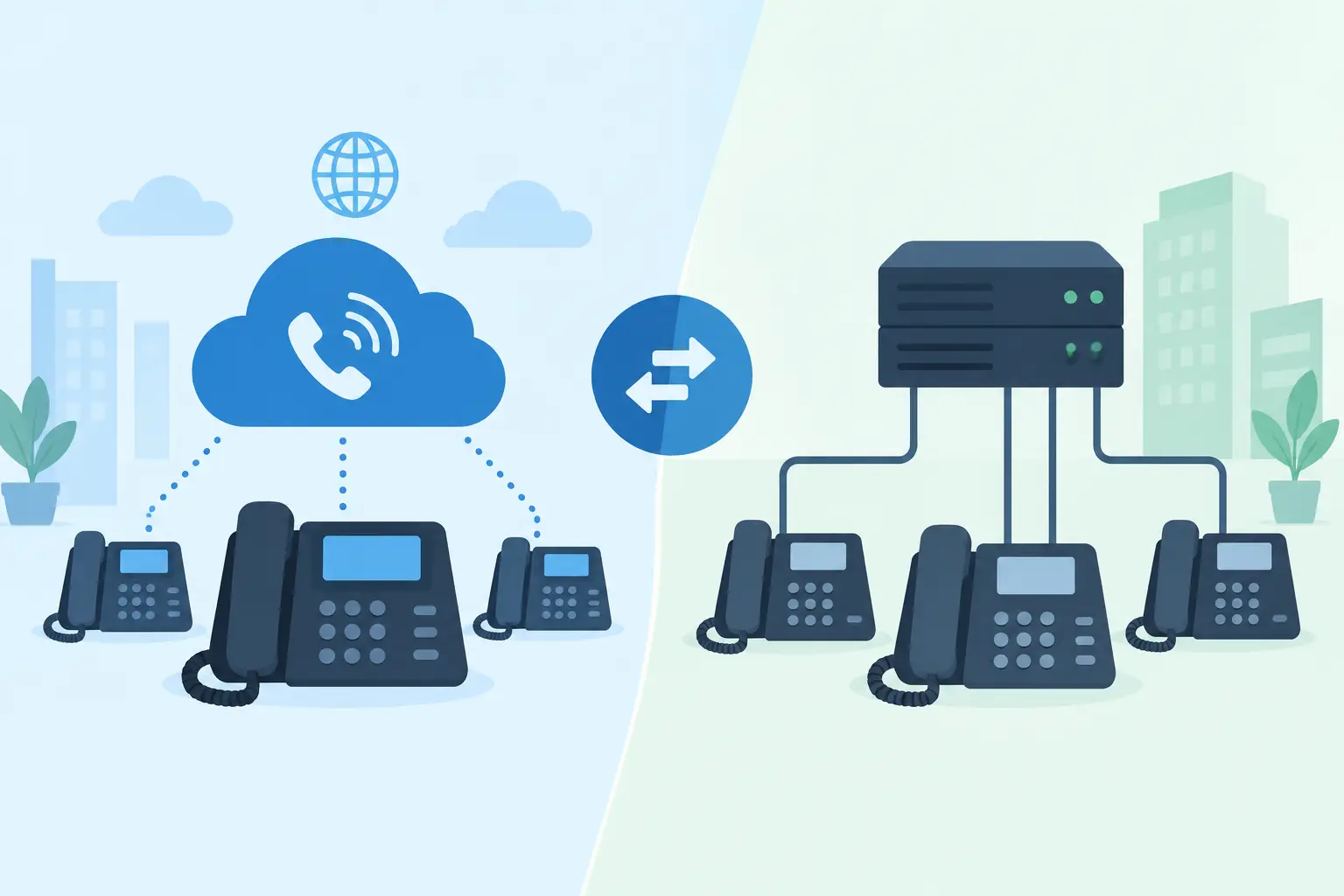
A PRI circuit that has carried an organization reliably for years can feel like the safest choice. But when capacity is fixed in blocks, remote sites need calling, or a carrier contract comes up for renewal, the economics and operational limits become harder to ignore. SIP trunking versus PRI is not simply a choice between old and new phone technology. It is a decision about how your organization buys call capacity, protects continuity, supports users, and prepares for future requirements.
For IT, operations, and procurement leaders, the right answer depends on more than a monthly rate. Existing PBX equipment, network readiness, call patterns, geographic footprint, failover requirements, and compliance obligations all deserve a place in the decision.
SIP Trunking Versus PRI: The Core Difference
PRI, or Primary Rate Interface, is a traditional digital telephone service delivered over dedicated telecommunications facilities. A standard PRI typically provides 23 voice channels and one signaling channel, allowing up to 23 concurrent calls. Organizations often add capacity in another block of 23 channels, whether they need all of them or not.
SIP trunking delivers voice service over an IP connection. Instead of relying on a dedicated PRI circuit and fixed channel blocks, SIP trunks use Session Initiation Protocol to establish and manage calls between an organization’s phone system and the public telephone network. Capacity can generally be sized around the number of simultaneous calls the organization actually expects to support.
That distinction affects nearly every practical consideration. PRI is tied more closely to a physical location and circuit. SIP is more flexible by design, but it requires a well-engineered network and thoughtful security controls. Neither service is automatically right for every environment.
Why Organizations Move From PRI to SIP
The most immediate reason to evaluate SIP is flexibility. A growing contact center, school district, multi-site business, or agency may need to add calling capacity without waiting for new physical circuits or purchasing unused channels. SIP can make that adjustment more straightforward, particularly when usage fluctuates by season, project, or operating location.
SIP also supports centralized voice architecture. Rather than maintaining separate local PRI circuits at every office, an organization may route multiple sites through a centralized PBX, cloud platform, or session border controller. This can simplify administration, standardize dialing plans, and improve visibility into voice services.
Business continuity is another meaningful advantage. With the right design, inbound calls can be rerouted to alternate offices, mobile devices, contact centers, or preconfigured failover destinations if a site becomes unavailable. PRI can support redundancy, but it often requires redundant local circuits and more physical infrastructure. SIP gives organizations more routing options, though those options must be designed and tested before an outage occurs.
Cost control often favors SIP as well. PRI billing can include circuit charges, local access fees, and capacity that remains unused. SIP pricing may better align with concurrent call requirements, especially for organizations consolidating sites or replacing aging phone systems. Still, a lower per-channel price is not the only cost consideration. Network upgrades, session border controllers, implementation services, and redundant connectivity can affect the total project cost.
Where PRI Still Has a Place
PRI is not obsolete simply because SIP is more adaptable. Some organizations operate stable, on-premises PBX systems with predictable calling volumes and limited plans for expansion. If the existing circuit is dependable, contract terms are favorable, and the organization has no need for centralized or cloud-based calling, retaining PRI temporarily may be a reasonable operational decision.
Certain facilities also value the perceived separation of a dedicated voice circuit from the data network. That separation can reduce concerns about internal bandwidth contention, although it does not replace the need for carrier diversity, power protection, and tested disaster recovery procedures.
The trade-off is that PRI infrastructure is becoming less attractive to carriers and more difficult to scale efficiently. Availability, repair timelines, and long-term support can vary by market. Organizations using PRI should understand their provider’s roadmap and avoid waiting until a circuit issue or contract deadline forces a rushed migration.
Reliability Depends on Architecture, Not the Label
A common misconception is that PRI is inherently more reliable than SIP because it uses a dedicated circuit. PRI can be very dependable, but it remains vulnerable to local carrier outages, facility damage, power loss, and single-site failures. A single circuit is still a single point of failure.
SIP reliability depends on the full voice architecture. Internet connectivity, quality of service policies, firewall configuration, DNS design, session border controllers, carrier redundancy, and failover rules all matter. A poorly configured SIP deployment can produce call quality problems. A properly designed deployment can provide geographic redundancy and recovery options that are difficult to achieve with a single PRI circuit.
For organizations where calling is mission-critical, the question should be: what happens if the primary carrier, local access circuit, PBX, office, or power source fails? The answer should include documented call-routing plans, alternate connectivity, monitored systems, and regular failover testing.
Voice quality also requires attention. SIP shares network resources with other traffic unless the network is intentionally engineered to prioritize real-time voice. IT teams should validate bandwidth, latency, jitter, packet loss, and quality of service policies before migration. This is particularly relevant for high-call-volume offices, remote users, and sites connected through variable broadband services.
Security and Compliance Require Deliberate Design
SIP is not inherently insecure, and PRI is not automatically compliant. Security and compliance depend on the controls surrounding the service.
A secure SIP design commonly includes a session border controller, strong authentication, encryption where supported and required, network segmentation, fraud monitoring, and clear administrative controls. The session border controller is especially important because it can protect the PBX from malicious traffic, manage interoperability, enforce call policies, and help prevent toll fraud.
Regulated organizations should also evaluate the service provider’s operational practices. Government agencies, contractors, healthcare-adjacent organizations, and educational institutions may need to consider data handling, administrative access, support processes, logging, and platform authorization requirements. For example, organizations operating in GCC High environments need PSTN connectivity designed to align with their Microsoft deployment and compliance obligations.
Compliance cannot be added at the end of a migration. It should shape carrier selection, solution architecture, implementation planning, and ongoing support from the beginning.
How to Make the Right Decision
The best evaluation starts with current-state facts rather than a preference for a particular technology. Document concurrent call peaks, not just the number of phone extensions. Review all sites, phone numbers, analog dependencies, call flows, emergency-calling requirements, and contract dates. An organization with 300 handsets may only need 60 concurrent call paths, while a busy service center may need considerably more.
Next, assess the PBX and network. Some legacy systems can use SIP with a compatible interface card or gateway. Others may be better candidates for a broader cloud voice or UCaaS transition. Check whether each location has sufficient bandwidth and whether a secondary connection is available for critical sites.
Then define continuity requirements in business terms. A public-sector help desk, admissions office, healthcare scheduling team, or emergency operations center may need calls rerouted within minutes. A small administrative office may accept a simpler recovery model. The technical design and monthly spend should reflect the real consequence of a communications outage.
Finally, compare providers on more than porting timelines and per-channel cost. Evaluate implementation support, escalation procedures, network redundancy, number management, security capabilities, and experience with your operating environment. A consultative provider should be able to explain the architecture clearly, identify migration risks early, and support a staged cutover when appropriate.
Plan the Migration Before You Need It
A PRI-to-SIP migration should not begin with disconnecting the old circuit. It should begin with a documented design, number-porting plan, test schedule, and rollback approach. In many cases, organizations can run services in parallel during transition, validate call routing and quality, and move numbers in controlled phases.
Pay close attention to equipment that may not appear on a standard phone inventory. Fax machines, elevator lines, alarm panels, intercoms, gate controls, point-of-sale terminals, and emergency devices may require separate solutions. SIP trunking can modernize core voice service, but it is not a universal replacement for every legacy analog endpoint.
For organizations with compliance requirements or distributed operations, implementation support can be as valuable as the service itself. Intuity helps organizations assess voice infrastructure, design secure connectivity, and build continuity plans that fit their operational and regulatory needs.
The practical next step is to inventory your current voice environment before a carrier deadline or service issue forces the decision. A clear view of call capacity, network readiness, critical lines, and recovery priorities will make the right path between PRI, SIP, or a phased transition much easier to defend.