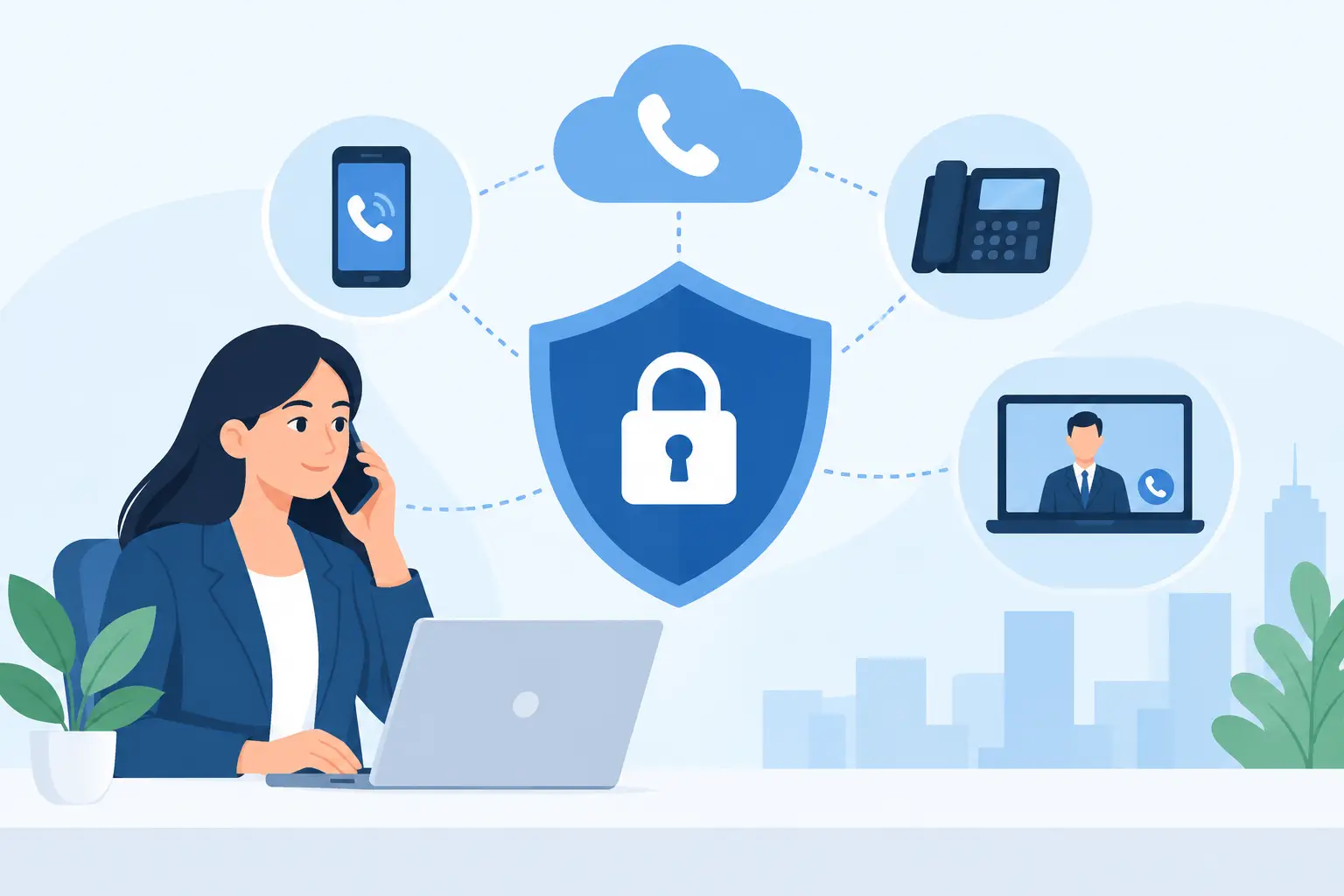
A suspicious spike in international call volume can become a five-figure loss before the workday begins. A compromised extension can also expose sensitive conversations, disrupt a call center, or give an attacker a path into adjacent systems. VoIP security is therefore not just an IT checklist item. It is an operational requirement for organizations that depend on voice communications to serve customers, coordinate staff, and meet compliance obligations.
Cloud calling can reduce the cost and complexity of legacy phone systems, but moving voice traffic to an IP network changes the risk profile. The right approach protects signaling, media, identities, devices, and the network paths that connect them. It also preserves the availability of calling during an attack, outage, or configuration error.
Why VoIP Security Requires More Than Encryption
Encryption is essential, but it addresses only part of the problem. Secure SIP signaling and encrypted voice media help prevent interception and tampering while calls are in transit. They do not stop an attacker who has stolen a user credential, exploited an exposed management portal, or used a poorly restricted SIP trunk to place fraudulent calls.
Enterprise voice environments must account for several connected risks. Toll fraud occurs when unauthorized users make expensive calls through a compromised account or trunk. Eavesdropping can expose customer information, student records, financial details, or government communications. Denial-of-service attacks can overload voice infrastructure and prevent users from placing or receiving calls. Misconfigurations can be just as damaging, particularly when permissive calling rules or outdated devices remain in service.
The consequences vary by organization. A retail business may focus on preventing fraud and keeping customer lines open. A school district needs reliable emergency calling, controlled access for staff, and protection for sensitive information. Government agencies and contractors may need an architecture that aligns with strict requirements for handling regulated workloads. The controls should match the actual use case, risk tolerance, and compliance scope rather than follow a one-size-fits-all template.
Core Controls for VoIP Security
A secure voice environment is built in layers. Each layer limits the damage if another control fails.
Encrypt signaling and voice media
SIP traffic contains call setup information such as user identities, dialed numbers, and routing instructions. Transport Layer Security, or TLS, protects this signaling from interception and modification. Secure Real-time Transport Protocol, or SRTP, encrypts the audio stream itself.
Both controls should be configured consistently between endpoints, session border controllers, and the service provider. Encryption can introduce compatibility considerations with older handsets, analog adapters, or third-party applications. That is a reason to plan migration carefully, not a reason to leave communications unprotected.
Use a session border controller
A session border controller, often called an SBC, is a critical boundary between an organization’s network and external voice services. It can validate SIP traffic, enforce dialing policies, hide internal network details, manage interconnection between platforms, and help defend against malformed or malicious traffic.
For organizations with multiple sites, remote users, contact center integrations, or SIP trunking, the SBC should be treated as a security control rather than a simple routing device. Its policies must be reviewed as the environment changes. A rule that was appropriate for one office may be unnecessarily broad once the organization adds remote calling or new vendors.
Strengthen identity and administrative access
Many voice incidents begin with a compromised password. Administrative portals, softphone applications, voicemail systems, and collaboration platforms should use strong authentication controls. Multifactor authentication is particularly valuable for privileged accounts and remote administrative access.
Apply role-based access so users can perform only the tasks required for their role. A help desk employee may need to reset a voicemail PIN, while a telecommunications administrator may manage call routing. Neither role should automatically have unrestricted access to billing, trunk configuration, or security logs. Remove accounts promptly when employees, contractors, or service providers no longer require access.
Limit calling exposure and monitor for fraud
International dialing, premium-rate destinations, and high-cost calling routes should be enabled only where there is a clear business need. Set sensible spending thresholds, call-volume limits, and destination restrictions. For some organizations, international calling may be allowed only for a small group of approved users or through a defined approval process.
Monitoring matters because fraud often appears as a pattern before it becomes a major loss. Watch for calls outside normal operating hours, repeated short calls to unfamiliar destinations, rapid increases in concurrent calls, and failed registration attempts. Real-time alerts give the organization and provider an opportunity to suspend suspicious activity before charges accumulate.
Segment voice traffic and protect endpoints
Voice systems should not share unrestricted network access with every workstation, printer, camera, and guest device. Network segmentation, often using a dedicated voice VLAN and appropriate firewall policies, reduces exposure and helps prioritize call quality. Quality of service settings are not a security control by themselves, but they support continuity by helping critical voice traffic perform reliably under load.
IP phones, softphone clients, analog telephone adapters, and conference devices all require management. Keep firmware current, change default credentials, disable unused services, and maintain an inventory of active endpoints. A forgotten phone in an empty office or an unmaintained adapter at a remote site can become an easy target.
Design for Availability, Not Just Confidentiality
Security and reliability are closely connected in voice communications. An environment that encrypts calls but fails during a carrier issue or distributed denial-of-service event still creates a serious operational problem. For many organizations, the ability to place emergency calls, reach customers, and maintain internal coordination is the central requirement.
That calls for redundancy in the parts of the environment that can fail: internet connectivity, SIP routing, power, cloud infrastructure, and call paths. Automatic failover to alternate numbers or locations can keep essential calls moving when a site loses service. Geographic redundancy can reduce the impact of a regional event. The correct design depends on call volume, acceptable downtime, emergency calling responsibilities, and the cost of interruption.
A documented incident plan is equally important. Teams should know who can change routing, who receives security alerts, how to contact the voice provider, and how to activate business continuity procedures. Test those procedures before an emergency. A failover plan that has never been validated is an assumption, not a safeguard.
Compliance Considerations for Regulated Organizations
Compliance does not replace security engineering, but it establishes a discipline for proving that controls are in place. Organizations handling regulated information need to understand where call records, voicemail, recordings, user data, and administrative logs are stored and who can access them.
Government agencies and contractors working in GCC High or FedRAMP-aligned environments should verify that PSTN connectivity and voice integrations support their specific architecture and authorization requirements. Education and healthcare organizations should review retention, access controls, recording practices, and vendor responsibilities with their legal and compliance teams. Requirements can differ based on the data discussed on calls, the systems integrated with voice services, and contractual obligations.
Ask providers direct questions about encryption, access management, logging, incident response, geographic redundancy, support escalation, and change management. A provider should be able to explain how its service fits into your security model, where responsibilities begin and end, and how it supports continuity when something goes wrong.
Build VoIP Security Into Everyday Operations
The strongest technical design can weaken over time if it is not maintained. Review user access regularly, audit calling permissions, apply updates, and examine logs for unusual behavior. Reassess configurations after mergers, office moves, new integrations, or major workforce changes. These are common moments when outdated routes and unnecessary privileges remain in place.
Security awareness also has a role. Employees should know how to recognize suspicious voicemail messages, unexpected password prompts, and requests to change call forwarding. Administrators should understand the financial and operational impact of a quick configuration change. Clear processes prevent routine support actions from becoming security gaps.
For organizations replacing PRI, analog lines, or fragmented voice services, the migration is an opportunity to improve more than cost control. It is a chance to establish accountable ownership, documented policies, resilient call routing, and security controls that fit the way the organization actually operates. A consultative provider such as Intuity can help align that design with technical, compliance, and continuity requirements before the first number is ported.