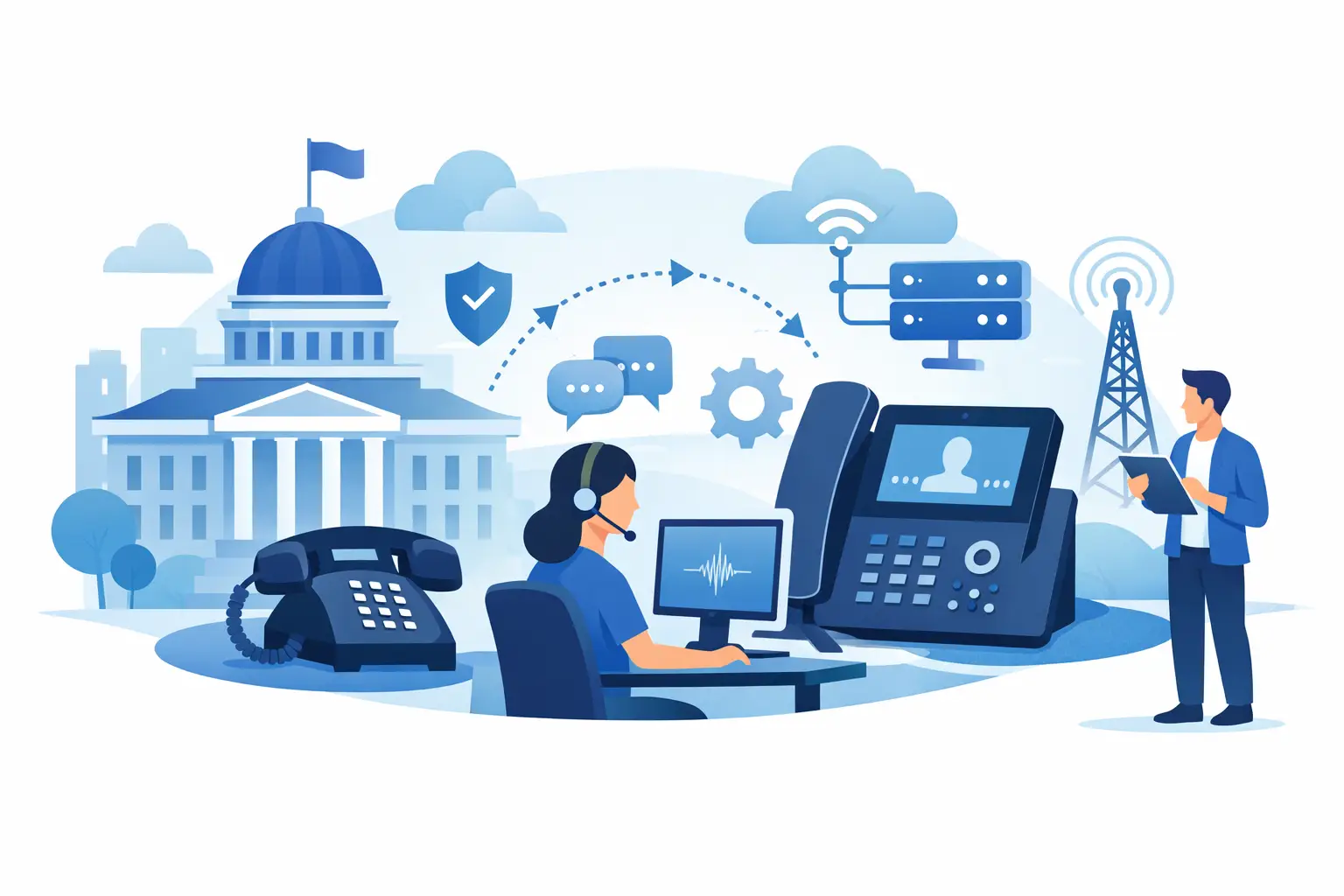
A missed call to a public safety desk, benefits office, or procurement line is not a minor inconvenience. For many agencies, it becomes a service failure, a compliance risk, or a continuity issue that surfaces during the worst possible moment. That is why a government agency telephony upgrade is no longer just an IT refresh. It is an operational decision that affects security, responsiveness, and the agency’s ability to serve the public without disruption.
Legacy PRI circuits, aging PBX platforms, copper lines, and patchwork carrier contracts still support critical communications across federal, state, and local environments. Many of those systems were dependable for years. The problem is that dependable is not the same as sustainable. Support is shrinking, hardware is harder to replace, and the old model does not align well with hybrid work, centralized compliance requirements, or modern disaster recovery expectations.
Why a government agency telephony upgrade is now a priority
Agencies are under pressure from several directions at once. Budget owners want tighter cost control. IT leaders need fewer single points of failure. Security teams need clearer boundaries around voice traffic, administrative access, and data handling. Operations leaders need staff to remain reachable whether they are in a headquarters building, a satellite office, or a remote setting.
Legacy telephony tends to work against those goals. It often creates fragmented environments where one office has a premise-based system, another depends on analog lines, and another uses a separate carrier arrangement with limited visibility. That fragmentation increases administrative effort and makes continuity planning much harder than it needs to be.
A modern telephony environment can consolidate voice infrastructure, improve routing resilience, and support policy-driven administration. It can also bring agency communications closer to the security and compliance posture already expected in email, collaboration, and identity systems. That matters in regulated environments where communications infrastructure cannot be treated as an afterthought.
What legacy systems usually get wrong
The biggest issue is not age alone. It is mismatch. Older voice systems were designed for a world where staff, numbers, and offices were relatively fixed. Agencies today need something more flexible.
A common problem is limited survivability. If one circuit fails or one location goes offline, call handling may be degraded across multiple departments. Another is poor scalability. Adding users, moving numbers, or expanding to a new office often requires carrier coordination, new hardware, or time-consuming reconfiguration. Costs also become less predictable when agencies are paying to maintain obsolete equipment while carrying overlapping services to fill capability gaps.
Security is another pressure point. Older systems may not offer the administrative controls, encryption options, segmentation strategies, or auditing visibility expected in modern environments. That does not mean every legacy deployment is automatically insecure. It does mean the burden of compensating controls tends to rise over time, and that burden usually falls on already stretched internal teams.
What to evaluate before starting the upgrade
A successful upgrade starts with requirements, not product selection. Agencies should first define what the phone system must support operationally. That includes core call flows, emergency and after-hours handling, contact center needs, remote and field user access, fax or analog dependencies, and integration with existing platforms.
The next layer is compliance and hosting posture. A county office may have different requirements than a federal agency, and a civilian department may differ from a government contractor operating in GCC High or similar environments. Voice architecture, administrative controls, data residency expectations, and PSTN connectivity options should all be evaluated in that context.
Network readiness also matters. A cloud migration can improve reliability, but only if underlying bandwidth, routing, and failover planning are adequate. Agencies do not need perfect conditions on day one, but they do need an honest assessment of where the network can support real-time voice traffic and where upgrades or policy changes are required.
Choosing the right path for a government agency telephony upgrade
There is no single blueprint that fits every agency. Some benefit from a phased migration that starts with SIP trunking to stabilize costs and retire old circuits while preserving existing call control for a period of time. Others are better served by moving directly to a cloud-based voice model that reduces infrastructure burden and centralizes administration.
The right path depends on a few practical variables. If the current PBX is near end of life and vendor support is weak, a direct move may make more sense. If the agency has specialized analog endpoints, legacy paging, elevator lines, or location-specific workflows, a staged approach may reduce disruption. If compliance requirements are especially strict, architecture choices need to be aligned early so there is no disconnect between security expectations and telephony design.
This is where a consultative provider adds value. The goal is not to force a one-size-fits-all migration. The goal is to map voice requirements to an environment that is secure, supportable, and financially realistic.
Security and compliance should shape the design
In government settings, telephony cannot be evaluated on features alone. Security and compliance need to be built into the service model.
That includes how voice traffic is transported, how administrative access is controlled, how redundancy is handled, and how the environment supports agency-specific regulatory obligations. For some organizations, that means aligning with FedRAMP-authorized communications services or enabling GCC High PSTN connectivity. For others, it may mean focusing on tighter carrier management, stronger continuity planning, and cleaner separation between departments and user groups.
There is also a procurement reality here. Agencies often need solutions that can be justified not just technically, but operationally and contractually. A telephony partner should be able to explain where security controls sit, how support is delivered, what happens during an outage, and how the service can scale without forcing a redesign every time the agency changes.
Cost savings are real, but they are not automatic
One of the strongest cases for modernization is cost control. Retiring PRI lines, reducing maintenance on aging hardware, consolidating vendors, and simplifying moves and changes can lower ongoing spend. That said, savings depend on how the migration is structured.
An agency that keeps too much legacy infrastructure in parallel for too long may delay the financial benefit. On the other hand, a rushed cutover that overlooks analog dependencies or training needs can create avoidable disruption and hidden costs. The better approach is to build a migration plan that identifies where costs can be removed early and where temporary overlap is justified to protect continuity.
It is also worth looking beyond monthly line items. Staff time spent troubleshooting carrier issues, manually managing call flows, or sourcing discontinued parts has a cost. A more centralized and supportable voice environment often improves internal efficiency in ways that are not immediately obvious in a telecom invoice.
Implementation is where projects succeed or fail
Most telephony problems do not come from the technology itself. They come from incomplete discovery, weak number porting coordination, poor testing, or unclear ownership during deployment.
A disciplined implementation should begin with inventory validation. Agencies need a full picture of numbers, circuits, call paths, auto attendants, hunt groups, analog devices, emergency location requirements, and any integrations that support daily operations. From there, migration sequencing should reflect business risk. Critical departments should be tested more extensively, and fallback plans should be documented before any cutover date is set.
Training should not be treated as optional. Even if the new environment is intuitive, users need to know how calls are routed, what changes in their daily workflow, and how to reach support if something is not working as expected. Administrative teams also need clarity around who manages policy, who handles changes, and how escalation works after go-live.
For agencies that need a secure, compliant voice environment with tailored support, providers such as Intuity can help bridge the gap between technical design and operational rollout. That matters when the project involves more than replacing dial tone.
What good looks like after the upgrade
The end state should be easier to manage than what came before. Agencies should have clearer visibility into services, stronger continuity options, and more confidence that voice communications will keep working when a site, circuit, or staffing model changes.
Good outcomes usually include centralized administration, simpler carrier relationships, more resilient routing, and a cleaner path for supporting remote or distributed users. Just as important, the telephony environment should fit the agency’s compliance posture instead of forcing teams to work around its limitations.
A government agency telephony upgrade is most successful when it is treated as part of a broader communications strategy rather than a narrow equipment replacement. Agencies that plan carefully tend to end up with more than modern phone service. They gain a platform that supports continuity, public service delivery, and long-term control over cost and risk.
The practical question is not whether legacy voice can keep limping along for another budget cycle. It is whether that risk still makes sense when better options are available and the stakes of a communications failure remain so high.