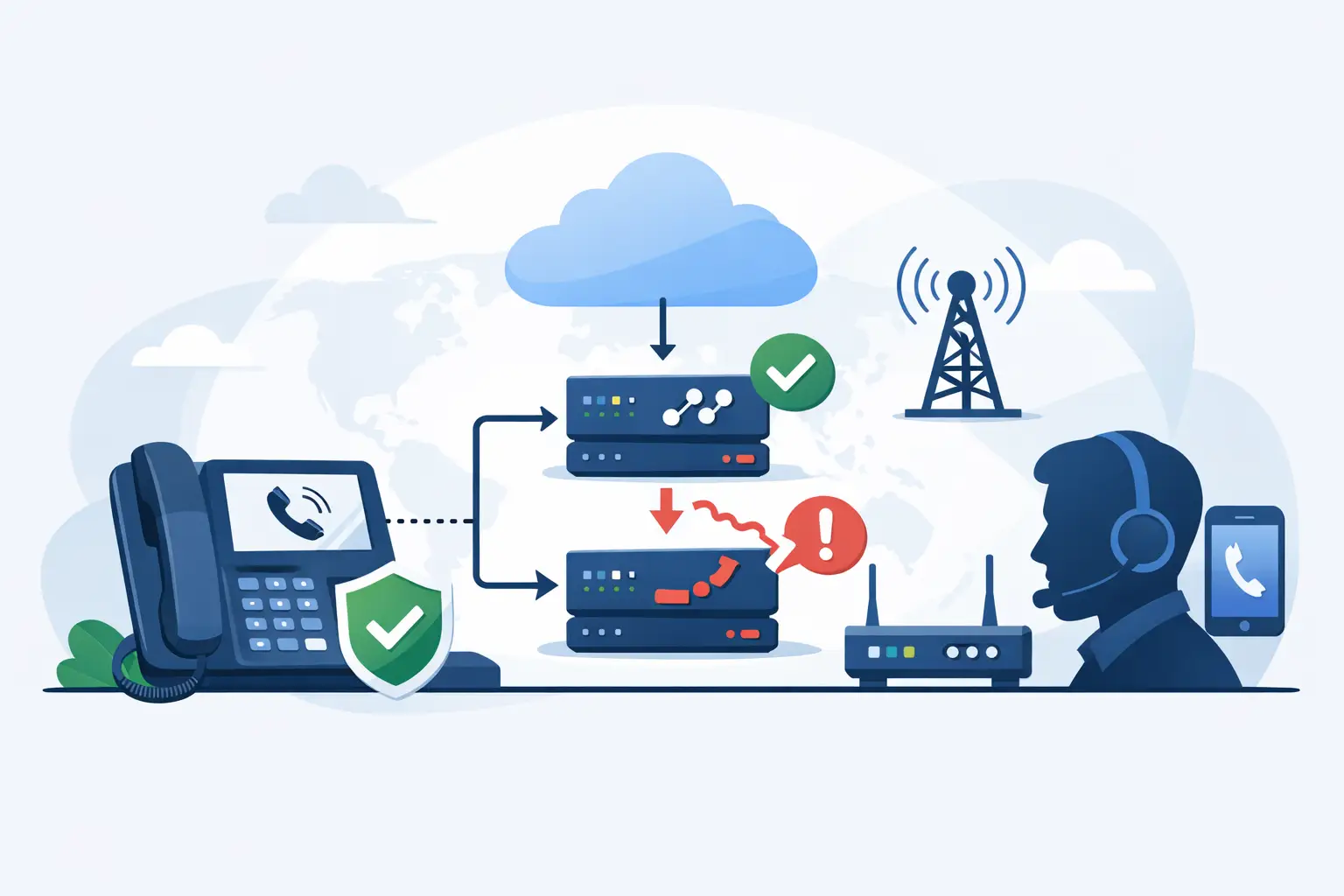
A phone outage rarely starts as a phone problem. More often, it begins with a carrier issue, a circuit failure, a misconfigured edge device, or a local power event that takes voice traffic down with it. That is why SIP failover setup matters. For organizations that depend on inbound access, emergency calling, contact center availability, or regulated communications continuity, failover is not an optional feature. It is part of the design.
In practice, a good failover strategy protects more than dial tone. It protects service levels, customer access, internal operations, and in some environments, compliance obligations. If your teams support students, patients, citizens, branch offices, or distributed staff, even a short interruption can create operational risk that spreads well beyond the telecom team.
What SIP failover setup actually does
At a basic level, SIP failover setup ensures calls continue to route when the primary path is unavailable or degraded. The primary path might be a SIP trunk, an internet circuit, a session border controller, a PBX instance, or a local site itself. When one of those elements fails, traffic shifts to a secondary path based on predefined rules.
That sounds straightforward, but there are several layers to consider. Some failover designs reroute inbound calls to another site or to backup numbers. Others move SIP registration to a secondary platform, redirect outbound calling through a different trunk group, or send users to softphones and mobile endpoints when a location goes dark. The right design depends on where your real point of failure is.
This is where many organizations get tripped up. They assume carrier redundancy alone solves the problem, but a second carrier does not help if both services terminate at the same firewall, the same power source, or the same building. A useful failover plan looks at the full call path, not just the trunk provider.
The main SIP failover setup models
Most environments use one or a combination of three approaches.
Carrier-level failover
This is the most familiar option. If the primary SIP trunk or route becomes unavailable, traffic is sent over a secondary trunk or alternate carrier path. For many organizations, this is the starting point because it addresses upstream provider outages and routing issues.
Carrier-level failover is valuable, but it has limits. If your PBX is down, your internet connection is unavailable, or your local session border controller fails, the carrier may still be able to hand off calls somewhere else, but not necessarily to the users who need them.
Site-level failover
This model shifts traffic from one office or campus to another. If a branch loses connectivity, inbound calls can be redirected to a headquarters location, another regional office, or a centralized call handling team. This is often a strong fit for school systems, healthcare groups, multi-site businesses, and public-sector organizations with distributed operations.
Site failover is effective when teams can absorb calls from another location. The trade-off is operational. If call flows become too simplified during failover, users may lose department-level routing, local DID behavior, or site-specific caller experience.
User-level failover
Here, the goal is to preserve access to people rather than preserve the original technical path. Calls can ring mobile devices, soft clients, alternate user registrations, or remote endpoints. This model is especially useful for hybrid workforces and organizations moving away from fixed desk-only telephony.
The benefit is flexibility. The challenge is governance. In regulated environments, sending calls to unmanaged devices may raise security, retention, or policy concerns. Failover should support continuity, but it also has to align with how your organization controls communications.
Where organizations should start
The most effective SIP failover setup begins with a business impact discussion, not a product discussion. Before anyone talks through trunks, DNS behavior, or SBC clustering, answer a simpler question: what must stay available when something breaks?
For some organizations, the priority is preserving inbound main-number access. For others, it is emergency outbound calling, contact center continuity, or maintaining service for executive lines, public hotlines, or field teams. Those priorities shape the design.
It also helps to separate inconvenience from true business risk. A corporate office may tolerate temporary rerouting to voicemail or an alternate receptionist queue. A public agency intake line or a campus safety number likely cannot. Treating all numbers the same often increases cost without improving resilience where it matters most.
Designing around real points of failure
A resilient voice environment accounts for more than one outage scenario. The most common failures include circuit loss, local ISP instability, power disruption, PBX failure, SBC issues, carrier route problems, and configuration errors introduced during changes.
That last issue deserves attention. Many failover events are triggered not by infrastructure collapse but by a change window that went sideways. Routing updates, firewall modifications, certificate changes, and number translation edits can create a voice outage just as effectively as a hard failure. Good design reduces dependency on one correct configuration state.
For that reason, failover planning should include diverse connectivity where possible, power protection, geographically separated services, and tested alternate call routes. It should also include clear ownership. If multiple vendors are involved, determine in advance who validates call flow, who manages rerouting, and who has authority to make emergency changes.
SIP failover setup and compliance requirements
In regulated environments, resiliency and compliance are closely connected. An outage may affect more than operations if it interrupts mandated access, emergency communications, or controlled communications workflows.
Organizations supporting government, education, healthcare, and defense-related operations often need failover designs that preserve security controls even during an incident. That can affect where calls are redirected, which devices are allowed to receive them, how records are retained, and whether alternate paths remain within approved environments.
This is one area where generic failover templates fall short. A setup that works for a small commercial office may be unsuitable for a GCC High deployment or a communications environment tied to CMMC or FedRAMP expectations. Continuity plans should be reviewed in the context of policy, not just uptime.
Testing is where failover plans succeed or fail
A failover plan that has never been tested is a diagram, not a safeguard. The most common problem is not that failover never happens. It is that when it does happen, the organization discovers the real call flow does not match the intended one.
Testing should include more than dropping a trunk and confirming that some calls complete. Validate inbound and outbound behavior, direct inward dial numbers, auto attendants, hunt groups, emergency calling logic, fax or analog dependencies if they still exist, and after-hours routing. If remote users and mobile endpoints are part of the continuity plan, test those too.
It is also worth testing human response. During an outage, who knows whether to wait, escalate, or invoke rerouting? Who informs end users? Who verifies service restoration? Technical failover and operational readiness need to work together.
Common SIP failover setup mistakes
The biggest mistake is assuming redundancy exists because a vendor mentioned it during deployment. Redundancy for the provider does not automatically mean continuity for your organization. Ask where failover occurs, how quickly it happens, what triggers it, and which services are preserved versus degraded.
Another common mistake is protecting inbound calls while ignoring outbound. If users can receive calls but cannot place them, the business impact may still be severe, especially for support teams, safety personnel, or staff handling time-sensitive communications.
A third issue is overengineering. More layers are not always better. Complex routing chains can create confusion during troubleshooting and increase the chance of misconfiguration. The best failover designs are the ones your team can understand, document, and test consistently.
How to evaluate whether your current setup is enough
If your organization has SIP service today, a useful review starts with a few direct questions. What happens to inbound calls if your main site loses connectivity? What happens if your PBX platform is unreachable? Can critical users still place outbound calls? Are emergency calling rules preserved? How long would it take your team to confirm failover is working?
If the answer to any of those questions is uncertain, your current design may be more fragile than it looks.
This does not always mean a full rebuild is required. In many cases, targeted improvements make the biggest difference. That might mean adding alternate routing for key numbers, diversifying access paths, separating failover destinations by business function, or aligning telecom continuity with broader disaster recovery planning. A consultative provider can help map those gaps without forcing a one-size-fits-all architecture.
Reliable voice service is not the result of hoping your primary path never fails. It comes from deciding in advance how your organization should behave when it does, then building a SIP failover setup that matches your operational and compliance reality.