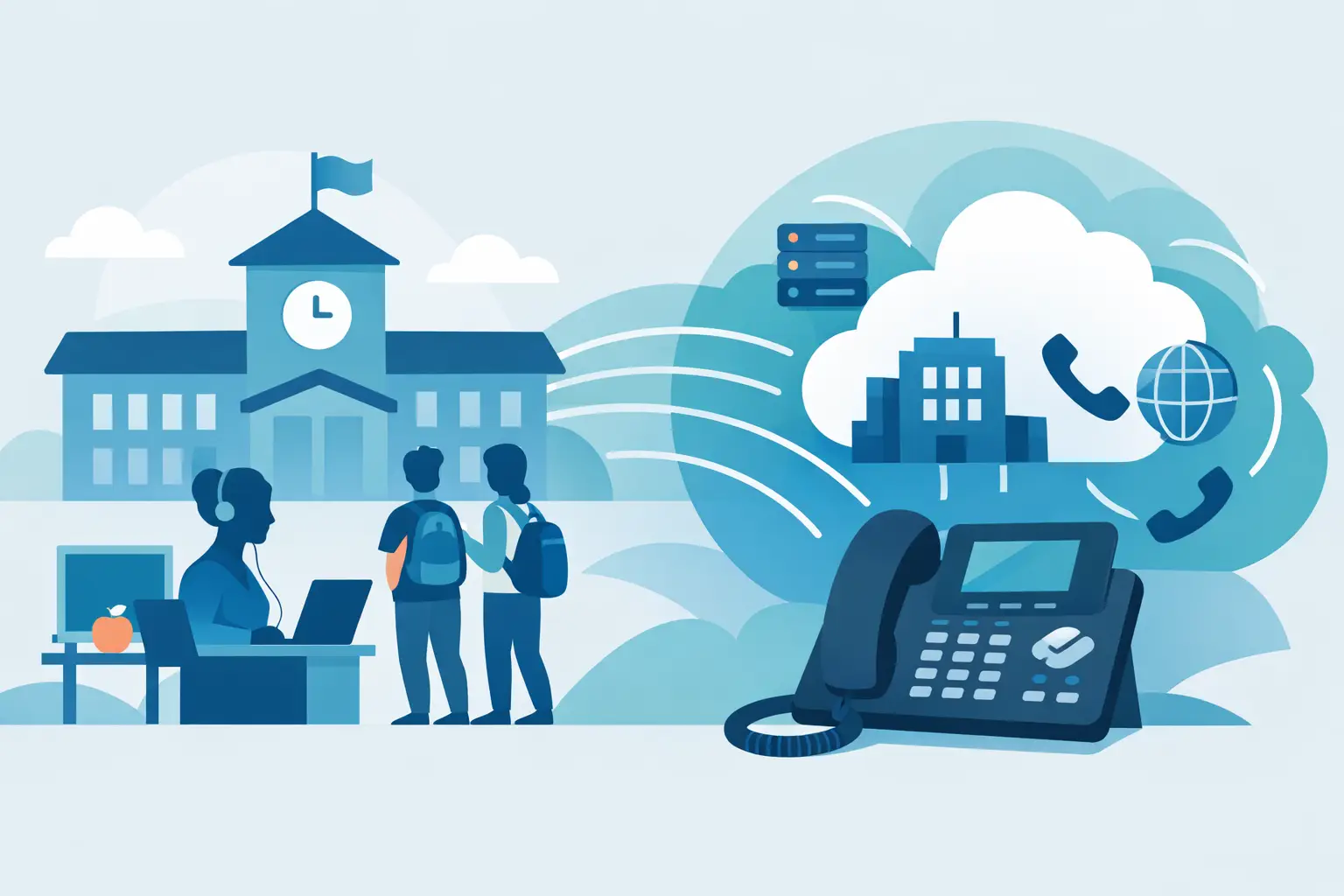
When a parent calls the attendance office, a teacher needs to reach the nurse, or a front desk team must contact first responders, the phone system is not a background utility. In a school environment, it is part of daily operations and part of the safety plan. That is why sip trunking for schools has become a practical priority for districts that are still relying on aging PRI circuits, analog lines, or a patchwork of campus-by-campus phone services.
For IT leaders and school administrators, the question is rarely whether voice service still matters. It is whether the current setup can support modern demands without driving up cost, complexity, or risk. SIP trunking gives schools a way to modernize voice infrastructure while keeping control over budgets, call reliability, and deployment timelines.
What sip trunking for schools actually means
SIP trunking connects a phone system to the public telephone network over an IP connection instead of traditional copper-based voice circuits. In practical terms, it replaces or reduces the need for PRI lines and many analog services while allowing schools to route calls through their existing data network or a dedicated connection.
That matters because most school districts are operating in mixed environments. Some campuses may still use older PBX hardware. Others may have moved to VoIP handsets, softphones, or cloud-based calling. SIP trunking can often bridge those environments, which makes it useful for districts that need to modernize in phases rather than replace everything at once.
For a superintendent or finance team, the value is not just technical. It is operational. You get more flexibility in how calling capacity is allocated, better visibility into usage, and a clearer path away from outdated carrier contracts that no longer fit how schools actually work.
Why schools are moving away from traditional phone lines
Many education organizations have reached the same point: the legacy voice environment still functions, but it no longer fits the institution. A PRI may be stable, yet it can be expensive to maintain, difficult to scale, and inefficient across multiple locations. Analog lines may remain necessary for a few use cases, but they should not define the architecture for an entire district.
School systems also face a very specific mix of demand. Call volume spikes at certain times of day, campuses may open or close programs from year to year, and central administration often needs more visibility across sites than older phone services were built to provide. SIP trunking addresses those pressure points by making capacity more flexible and administration more centralized.
There is also a staffing reality. K-12 IT teams are usually managing far more than telephony. They are supporting classroom technology, network access, cybersecurity, student devices, and administrative platforms at the same time. A voice environment that is easier to monitor and easier to scale reduces workload in a meaningful way.
The business case for SIP trunking for schools
Cost is often the first driver, but it should not be the only one. SIP trunking can reduce recurring telecom expenses by replacing fixed voice circuits with a model that better matches actual usage. That can be especially valuable for districts with multiple campuses or seasonal fluctuations in activity.
The stronger argument, however, is often efficiency. Instead of managing separate carrier relationships, separate billing structures, and separate line counts at each site, schools can move toward a more unified voice strategy. That simplifies procurement, planning, and support.
Reliability is another major factor. A well-designed SIP deployment can include failover options, redundant routing, and better continuity planning than older voice setups. That does not mean every environment becomes identical overnight. It means districts have more options to build for resilience rather than simply hoping legacy lines continue to hold up.
Scalability is where the difference becomes obvious. If a school adds a wing, opens a new campus, or expands remote administrative operations, SIP capacity can usually be adjusted far more easily than traditional circuits. The same is true when a district needs to consolidate systems after reorganization or standardize voice service across schools that historically operated independently.
Emergency calling and operational continuity
Any conversation about school telephony has to include emergency response. Schools need confidence that 911 calls route correctly, location information is handled properly, and voice services remain available during disruptions. This is one of the areas where planning matters more than promises.
SIP trunking can support E911 requirements, but the implementation has to reflect how the district actually operates. A single-site setup is different from a district with dozens of campuses, portable classrooms, administrative buildings, and shared spaces. Accurate location mapping, call routing logic, and testing are not optional details.
Power and connectivity dependencies also need to be addressed honestly. Traditional lines are often seen as safer simply because they are familiar, but that does not automatically make them more dependable in a modern school environment. SIP-based systems can provide strong resilience when designed with the right network readiness, backup power, and continuity strategy. Without that planning, the benefits narrow quickly.
For many districts, the right answer is not an all-or-nothing cutover. It is a staged design that preserves critical functions, supports emergency calling requirements, and reduces exposure during migration.
What schools should evaluate before migrating
The technical fit starts with the network. Schools need to understand available bandwidth, call quality readiness, failover paths, and whether the current LAN and WAN design can support voice traffic consistently. If call quality is poor because the underlying network is unstable, SIP trunking will not fix that by itself.
The phone system also matters. Some districts can connect SIP services to an existing IP-PBX or hybrid system and extend its useful life. Others are better served by combining SIP with a broader move to hosted voice. The right path depends on current infrastructure, budget timing, staffing, and the district’s long-term communications plan.
Compliance and recordkeeping may also shape the decision. Schools do not all face the same requirements, but public institutions still need dependable service, strong vendor accountability, and clear support processes. If a provider cannot explain resiliency, implementation sequencing, E911 support, and escalation procedures in plain terms, that is a warning sign.
Procurement teams should also look closely at billing flexibility. Fixed channel models may work in some cases, while usage-based or pooled models may better support districts with uneven call patterns. There is no universal best option. The best fit is the one that aligns with how the schools operate and how predictable the budget needs to be.
Common deployment models for school districts
Some districts centralize SIP trunking at a main data center and route calling for multiple campuses through a shared architecture. That can improve control and simplify administration, especially when internal IT resources are strong.
Others use a distributed model, where sites have localized survivability or a mix of on-premises and cloud-based voice services. This can make sense when campuses vary widely in age, network design, or operational autonomy.
A hybrid approach is often the most practical. Schools may retain certain analog services for elevators, alarms, faxing, or other edge cases while moving primary call flows to SIP. That kind of phased modernization is common because it balances budget realities with operational needs.
The key is not choosing the most advanced-looking model. It is choosing one that the district can support, secure, and scale without creating avoidable complexity.
Choosing the right provider for sip trunking for schools
Schools are not buying generic voice capacity. They are buying continuity, support, and accountability. A provider should be able to assess the current environment, identify risks before cutover, and recommend an approach that fits the district rather than forcing a standard package.
That consultative support matters during implementation, but it matters just as much after deployment. If a campus loses connectivity, if E911 records need updating, or if the district expands, response quality becomes part of the service itself.
This is where experience with public-sector and regulated environments tends to show. Providers that understand uptime expectations, multi-site coordination, security considerations, and structured implementation planning are better equipped to support schools over time. For districts that need a partner rather than a line vendor, that distinction is significant.
Modernizing school telephony does not have to mean replacing everything at once or taking unnecessary risk. The right SIP strategy gives schools room to improve reliability, control costs, and build a voice environment that matches how education operates now. If the phone system is part of your district’s daily workflow and part of your emergency response posture, it deserves the same level of planning as any other core infrastructure.