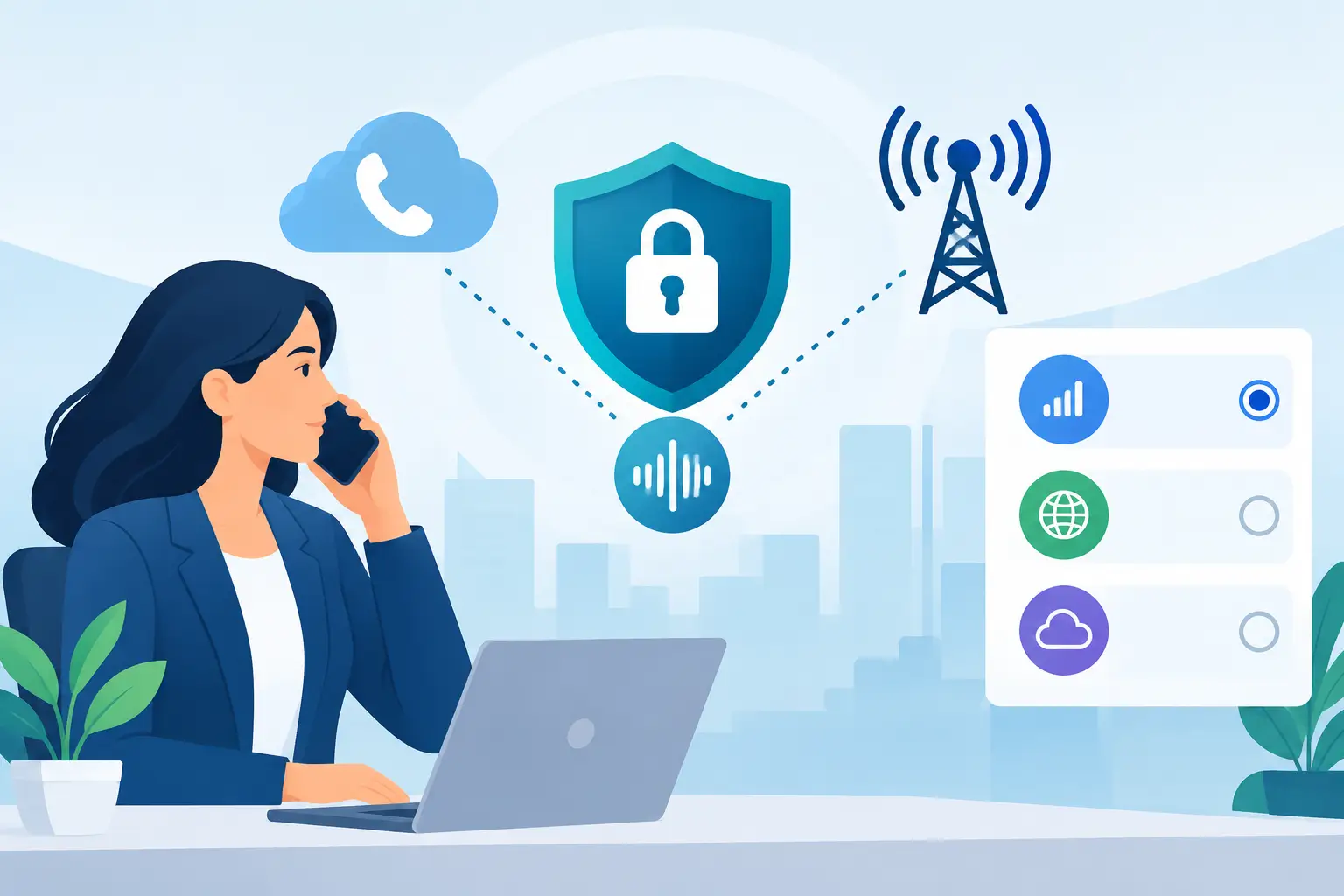
A telecom vendor selection guide should do more than compare monthly rates and calling features. For organizations replacing PRI, analog, or fragmented voice services, the vendor decision affects business continuity, security posture, compliance obligations, and the ability to support employees and customers when conditions are not ideal.
A low initial quote can look attractive until an outage exposes a lack of redundancy, a migration reveals undocumented fees, or a compliance review finds that the provider cannot support the required environment. The right evaluation process looks beyond the product list and tests whether a vendor can operate as a dependable communications partner.
Start with the operational problem, not the provider
Before reviewing vendors, document what your organization needs to change. A school district retiring analog lines has different priorities from a federal contractor requiring GCC High PSTN connectivity. A multi-site business moving from PRI may need number porting, survivability, and call routing more than a long list of collaboration features.
Define the services in scope, including SIP trunking, cloud voice, fax, emergency calling, alarm panels, elevators, and other POTS-dependent equipment. Identify every location, carrier circuit, phone number range, call flow, and business-critical device. This discovery work prevents a common procurement mistake: comparing proposals that appear similar but cover very different responsibilities.
It also helps separate requirements from preferences. Requirements are conditions the service must meet, such as US-based support, encrypted signaling, CMMC-aligned controls, or a documented disaster recovery approach. Preferences may include a particular portal design or optional analytics package. Both matter, but they should not carry the same weight in a final decision.
Evaluate reliability as an architecture, not a promise
Every telecom provider claims reliability. Ask how that reliability is designed, measured, and supported. A service-level agreement is useful, but it does not replace a technical explanation of what happens when a carrier route, data center, internet connection, or local power source fails.
A capable vendor should clearly explain its redundancy model. That includes geographically diverse infrastructure, carrier diversity where appropriate, failover routing, monitoring, and escalation procedures. For cloud voice, ask whether calls can be rerouted to mobile devices, alternate sites, or other designated endpoints if a primary office becomes unavailable.
Questions that reveal the real resilience plan
Request specifics about historical uptime, maintenance notifications, incident communication, and recovery expectations. Ask which parts of the service are managed by the vendor and which depend on your network, firewall, internet service provider, or on-site equipment.
The answer may be nuanced. No provider can guarantee call quality over an unmanaged internet connection, for example. A trustworthy vendor will state that limitation directly and help assess network readiness rather than treating it as an afterthought. This level of clarity is often more valuable than an unrealistic availability claim.
Put security and compliance requirements in writing
Security cannot be a generic line item for government agencies, education systems, healthcare-adjacent organizations, and contractors handling controlled information. The vendor must fit the communications environment your organization is required to maintain.
Start by identifying the applicable standards and contractual obligations. These may include FedRAMP requirements, CMMC expectations, CJIS-related policies, state privacy rules, records retention obligations, or internal security controls. If your team operates in Microsoft GCC High, confirm that the provider can deliver PSTN connectivity designed for that environment rather than assuming standard commercial calling services will satisfy the requirement.
Ask vendors how they protect voice signaling, administrative access, call records, and customer data. Review identity and access controls, encryption practices, audit logging, vulnerability management, incident response, and data handling procedures. Where formal authorizations or attestations are required, request current documentation and understand precisely which service components are covered.
Compliance is not simply a checkbox. It is an operating model. A vendor may have strong internal controls but still be a poor fit if its support processes, call recording options, data retention model, or subcontractor relationships do not align with your policies.
Examine implementation discipline before signing
A successful deployment depends on more than provisioning licenses or porting phone numbers. It requires a realistic plan for discovery, configuration, testing, user adoption, and cutover. Vendors should be able to describe who owns each task and what information they need from your team.
For number porting, ask about timelines, carrier dependencies, validation requirements, and contingency plans if a port is delayed. For a POTS replacement project, confirm how the provider will evaluate each legacy line and whether alternative connectivity is suitable for life-safety, security, payment, fax, or building systems.
A phased migration is often safer than a single cutover, particularly for organizations with multiple sites or complex call flows. It can expose network issues and training gaps before they affect the entire organization. The trade-off is that a phased approach may require temporary parallel services, so procurement teams should account for short-term overlap costs.
Assess support where it matters most
Support quality is difficult to judge from a sales presentation and easy to recognize during an outage. Ask who answers the phone, where support personnel are located, what hours they cover, and how severity levels are defined. For organizations that need domestic support or clearance-aware processes, those details should be contractual expectations rather than informal assurances.
Look for a provider that assigns responsibility through implementation and ongoing service. The best support model is not always the largest call center. It is the one that gives your IT team a clear path to knowledgeable people who understand the service design, can coordinate with upstream carriers, and provide useful updates during incidents.
Also consider routine needs. Can administrators make common changes through a portal? Is training available for reception teams and system owners? Will the vendor help troubleshoot call quality, routing, and network issues, or only issues within its own platform? The answers shape your internal workload for years after deployment.
Compare total cost, not just the recurring rate
A telecom proposal should make pricing understandable. Review monthly service charges alongside one-time implementation fees, porting costs, hardware, taxes and surcharges, usage charges, contract terms, and early termination conditions. If features such as call recording, e-fax, international calling, or failover routing are important, verify whether they are included or billed separately.
Cost control also means avoiding unnecessary capacity. A flexible plan that can scale with seasonal staffing, new locations, or changing call volumes may provide better long-term value than an oversized fixed commitment. On the other hand, the lowest-cost plan may shift more implementation, support, or resilience work to your internal team.
Create a comparison worksheet that scores each vendor against weighted criteria: technical fit, security and compliance, resiliency, implementation approach, support model, contract terms, and total cost. Procurement should participate, but the final selection should include the IT, security, operations, and facilities stakeholders who will live with the result.
Use the telecom vendor selection guide to validate fit
The strongest telecom vendor selection guide ends with validation, not a spreadsheet ranking. Before making an award, hold a technical review with the finalist. Walk through your critical call flows, compliance requirements, network assumptions, migration timeline, and escalation process. Ask the vendor to identify risks in the proposed design.
That conversation is revealing. A qualified provider will ask informed questions, acknowledge constraints, and offer practical options. It will not claim that every environment has the same answer.
For organizations modernizing business voice, the best vendor is the one that can make complex requirements manageable while protecting continuity, security, and budget discipline. Choose a partner prepared to support the communications environment you need on the day everything is working – and on the day it is not.