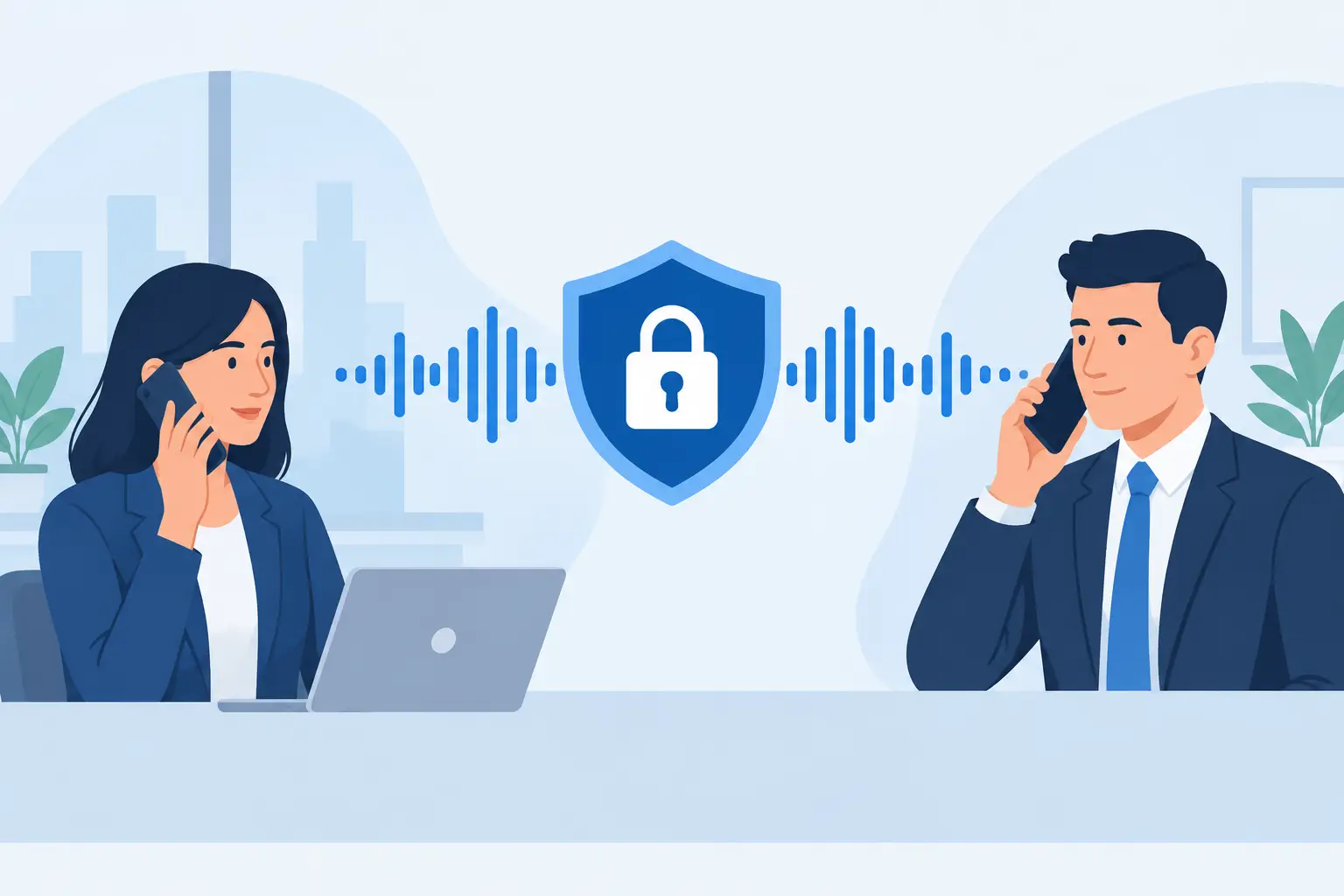
A phone call can contain more sensitive information than a long email thread: account details, student records, contract terms, patient information, incident response decisions, or controlled government data. Voice encryption requirements therefore need to cover more than a checkbox for “encrypted calling.” They must account for how call signaling, voice media, endpoints, networks, and administrative access are protected from the moment a call begins to the point relevant records are retained or deleted.
For IT and operations leaders, the goal is practical: reduce exposure without creating a calling environment that is difficult to manage, unreliable for remote staff, or incompatible with necessary systems. The right requirements depend on the organization’s risk profile, regulatory obligations, users, and voice architecture.
What voice encryption must protect
Enterprise voice traffic has two separate components. Signaling establishes, routes, transfers, and ends calls. It can include caller and called numbers, device information, call-routing data, and authentication details. Voice media is the actual audio stream carried during the conversation.
A secure design protects both. Encrypting voice media while leaving signaling exposed can reveal valuable call metadata or allow an attacker to interfere with call setup. Encrypting signaling without protecting media can leave the conversation itself vulnerable to interception. A useful baseline is Transport Layer Security, or TLS, for SIP signaling and Secure Real-time Transport Protocol, or SRTP, for voice media.
This distinction matters during procurement. A provider may describe a service as encrypted while only securing part of the call path. Decision-makers should ask where TLS and SRTP begin and end, whether they are enforced by policy, and what happens when a connected endpoint or carrier does not support them.
Voice encryption requirements start with the call path
Calls do not always travel in one protected environment. A typical cloud voice deployment may include desk phones, softphones, mobile devices, local area networks, internet connections, session border controllers, cloud calling platforms, SIP trunks, contact center tools, recording systems, and PSTN interconnection. Each handoff is a point that requires deliberate design.
Within the organization, encrypted calls still depend on endpoint security. A compromised laptop, unmanaged mobile phone, or incorrectly configured IP phone can expose audio before it is encrypted for transit or after it is decrypted for playback. Requirements should address device enrollment, supported firmware, strong administrator credentials, role-based access, and a process for removing lost or retired devices.
At the network edge, a session border controller can help enforce encryption policies, control approved interconnections, and limit fraudulent or malformed traffic. It is particularly valuable when organizations connect multiple locations, retain existing systems during a phased migration, or use SIP trunking with third-party platforms.
Encryption also has limits at the PSTN boundary. Traditional public telephone network segments are not typically end-to-end encrypted in the same way as a call between two managed encrypted endpoints. That does not make SIP or cloud calling insecure. It means organizations should distinguish between encryption in transit across the portions they control and true end-to-end encryption across every system in the call path. For most business calling environments, protecting managed segments and applying compensating controls at interconnection points is the realistic requirement.
Set protocol and cipher standards that fit the environment
A policy should name the standards the organization expects, not simply require “industry-standard encryption.” For SIP deployments, that commonly means TLS for signaling and SRTP for media. Web-based calling may use DTLS-SRTP to establish protected media sessions. The exact configuration should reflect current vendor support, interoperability needs, and security guidance.
Avoid requirements that force teams to retain outdated protocols merely because a legacy device cannot support modern encryption. If an older analog adapter, conference appliance, or on-premises PBX cannot meet the standard, document the exception, restrict its exposure, and establish a replacement timeline. Permanent exceptions tend to become invisible risks.
Cipher selection also deserves attention, although most organizations do not need to manage every technical setting themselves. The service provider should be able to explain which versions of TLS are supported, how weak ciphers are disabled, how certificates are validated, and how cryptographic updates are handled. This is especially relevant for organizations with contractual security requirements or formal assessments.
Key and certificate management cannot be an afterthought
Encryption is only as dependable as the keys and certificates behind it. Expired certificates can interrupt calling. Weak key storage can undermine otherwise sound protocols. Poorly controlled administrator access can allow unauthorized configuration changes that reduce protection.
Your requirements should establish who owns certificate lifecycle management, how renewals are monitored, how private keys are protected, and how access is reviewed. In a managed voice service, responsibilities may be shared: the provider manages platform certificates and infrastructure, while the customer manages local devices, identity systems, or network equipment. Those boundaries should be clear before implementation.
For high-assurance environments, ask whether administrative activities are logged, how privileged access is controlled, and how the provider notifies customers of security events that affect voice services. These operational details are often more useful than a broad statement that encryption is available.
Treat call recording as a separate security decision
A recorded call has a different risk profile from a live call. Once audio is stored, encryption in transit is no longer enough. Recordings, voicemail, transcriptions, and analytics data may require encryption at rest, access controls, retention schedules, audit logs, and secure deletion procedures.
Organizations should first decide whether recording is necessary for each call type. Sales quality assurance, emergency dispatch, financial transactions, and support operations can have legitimate reasons to record, but broader collection increases the amount of sensitive data that must be governed. State consent rules and sector-specific obligations may also affect notification and retention practices.
Where recording is required, define who can retrieve it, whether downloads are permitted, how long it is retained, and whether transcription providers receive any audio or text. A secure voice deployment should prevent recordings from becoming an unmonitored secondary data store.
Align encryption controls with compliance obligations
Encryption supports compliance, but encryption by itself does not establish compliance. A school system may need to consider student privacy obligations. Healthcare organizations must evaluate how protected health information is handled. Financial institutions may have contractual and regulatory controls for customer data. Government agencies and contractors may need to align voice architecture with requirements related to CMMC, FedRAMP-authorized services, or GCC High environments.
The appropriate evidence varies. Some organizations need configuration documentation, system security plans, audit logs, incident-response procedures, and supplier assessments. Others need clear confirmation that their voice service can operate within an approved cloud environment without moving sensitive call data into an unauthorized tenant or platform.
This is where a consultative provider adds value. Rather than promising that one feature satisfies every regulation, the provider should help identify the data involved, map the call flow, define shared responsibilities, and document the controls that apply to the organization’s use case.
Make reliability part of the security requirement
Security controls that disrupt calling can cause teams to work around them. If remote employees cannot reliably authenticate or calls fail after a certificate change, they may resort to personal devices, unapproved conferencing tools, or unrecorded channels. Availability is therefore part of a practical security posture.
Voice encryption requirements should account for redundant service architecture, network quality, failover routing, emergency calling capabilities, and support escalation. They should also include testing. A configuration that looks correct on paper can fail when a remote user connects from a restrictive network, a branch loses its primary internet connection, or a carrier handoff changes.
Test encrypted call setup, media quality, inbound and outbound routing, transfers, voicemail, emergency routing, and failover scenarios. Repeat testing after major network, device, identity, or provider changes. The objective is not only to prove that encryption is enabled, but to confirm that it continues to function during normal operations and disruption.
Questions to ask a voice provider
Before selecting or renewing a voice service, ask direct questions about the architecture. How are SIP signaling and media encrypted? Is encryption required by default, or can endpoints fall back to unencrypted connections? Where does the protected call path begin and end? How are certificates, keys, and privileged access managed? What happens to recordings, voicemails, and transcripts?
Also ask for the operational answer: who supports an encrypted endpoint that cannot register, how quickly can configuration issues be escalated, and what documentation is available for an audit or security review? A provider that can explain trade-offs clearly is more useful than one that responds only with product terminology.
For organizations replacing PRI, analog lines, or fragmented carrier services, encryption requirements are a chance to establish a cleaner communications standard rather than carry old assumptions into a cloud environment. Intuity can help teams evaluate secure SIP, cloud voice, PSTN connectivity, and compliance-oriented design against their actual call flows and operational priorities.
The most effective next step is to map one sensitive call from endpoint to destination, including any recording or transcription systems. That simple exercise often reveals exactly where your encryption requirements need to be more specific.